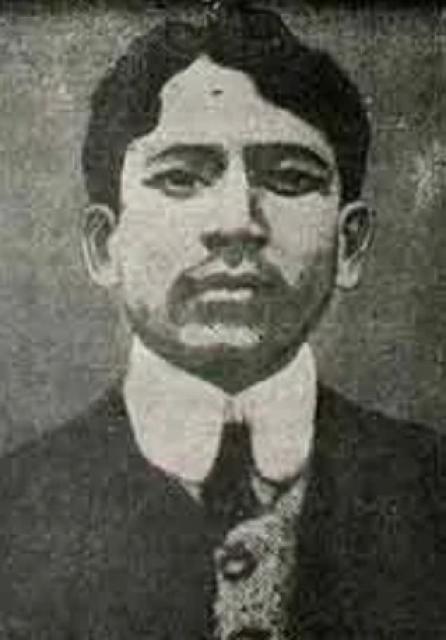
Madan Lal Dhingra
 India
India- Indian Revolutionary and Independence Activist
- Early Life and Education
- Nationalist Activism
- With Savarkar
- Curzon Wyllie Assassination
- Dhinga was immediately arrested at the scene by police.
- Legacy
Indian Revolutionary and Independence Activist
Madan Lal Dhingra, an Indian revolutionary and independence activist, assassinated William Hutt Curzon Wyllie, a British official, while studying in England.
Early Life and Education
Born on September 18, 1883, in Amritsar, India, to an affluent Hindu Khatri family, Madan Lal Dhingra was the son of Dr. Ditta Mal Dhingra, a civil surgeon. He was one of eight children, seven sons, and a daughter. All seven sons studied abroad.
Dhinga studied at MB Intermediate College in Amritsar until 1900. He then left for Lahore to attend Government College University. There, he was influenced by the emerging nationalist movement, which at the time advocated self-governance rather than independence.
Nationalist Activism
Dhinga was particularly troubled by India's poverty. He studied literature on the causes of Indian poverty and famine and believed that the keys to solving these problems lay in swaraj (self-governance) and the Swadeshi movement.
Dhinga eagerly supported the Swadeshi movement, which aimed to increase Indian self-reliance by encouraging Indian industry and entrepreneurship and boycotting British (and other foreign) goods. He felt that the colonial government's industrial and financial policies were designed to suppress indigenous industries and encourage the purchase of British imports, which he believed was a primary cause of India's lack of economic development.
In 1904, while pursuing a Master of Arts degree, Dhinga led a student protest against the principal's order for students to wear college jackets made from fabric imported from Britain. For this, he was expelled from college. His father, who held a high-paying government position and disapproved of agitators, instructed him to apologize to the college authorities, desist from further involvement in such activities, and get his expulsion revoked/avoided.
Dhinga refused and opted never to return home to face his father, instead supporting himself through work as he pleased. Thus, after his expulsion, Dhinga became a clerk in Kalka, at the foothills of the Shimla hills, for a firm that ran a Tanga carriage service to transport British families to Shimla for the summer months. After leaving that job due to a dispute, he worked as a mill worker. There, he attempted to organize a trade union but was fired for his efforts. He then moved to Bombay and worked there for a while, again in low-paying jobs.
By now, his family was seriously worried about him, and his elder brother, Dr. Behari Lal, compelled him to go to Britain to continue his higher education. Dhinga eventually agreed and departed for Britain in 1906 to study engineering at University College London.
With Savarkar
Dhinga arrived in London a year after Shyamji Krishna Varma's India House was established in 1905. This organization served as a meeting place for Indian revolutionaries, situated in Highgate.
Dhinga came into contact with prominent Indian independence and political activists Vinayak Damodar Savarkar and Shyamji Krishna Varma, who were impressed by his determination and strong patriotism, drawing him into the independence movement. Savarkar believed in revolution and inspired Dhinga's admiration for the cult of assassination.
Dhinga later distanced himself from India House and was known to frequent a shooting range on Tottenham Court Road. He joined and became a member of the secret society Abhinav Bharat Mandal, founded by Savarkar and his brother Ganesh.
During this period, Savarkar, Dhinga, and other student activists were outraged by the 1905 partition of Bengal. Dhinga was disowned by his father, Dittta Moll, who was the Civil Surgeon in Amritsar, for his political activities. His father went so far as to publish his decision in newspaper announcements.
Curzon Wyllie Assassination
A few weeks before assassinating Curzon Wyllie, Dhingra attempted to kill Lord Curzon, a former Viceroy of India. He also planned to kill Bamfylde Fuller, the former Lieutenant-Governor of East Bengal, but was late for an engagement they were both scheduled to attend and thus failed to carry out his plan.
Dhinga then turned his sights on Curzon Wyllie. Curzon Wyllie had joined the British Army in 1866 and the Political Department of India in 1879. He distinguished himself in various postings, including Central India and most notably in Rajasthan, where he rose to the highest rank in the service. In 1901, he was made the political aide-de-camp to the Secretary of State for India. He was also the head of the secret police and had attempted to obtain information on Dhinga and his fellow revolutionaries. Curzon Wyllie is said to have been a close friend of Dhinga's father.
On the evening of July 1, 1909, Dhinga attended an annual "At Home" event organized by the Indian National Association at the Imperial Institute along with a large gathering of Indians and Englishmen. As Curzon Wyllie, the Political Aide-de-Camp to the Secretary of State for India, was leaving the hall with his wife, Dhinga fired five shots directly at his face, four of which found their mark. Kaवास Lalcaca (or Lalkaka), a Parsi doctor who attempted to save Curzon Wyllie, was killed by Dhinga's sixth and seventh bullets, which he fired because Lalcaca had stepped between them.
Dhinga was immediately arrested at the scene by police.
TrialDhinga was tried at the Old Bailey on July 23. He conducted his own defense and did not recognize the legitimacy of the court. He stated that his assassination was done in the cause of Indian independence and was motivated by patriotism. He also stated that he had not intended to kill Kawas Lalcaca.
He was sentenced to death by hanging. It is said that after the judge pronounced his sentence, Dhinga stated, "I am proud to die for my country. But remember, there is a price to be paid by you people in the near future."
Madan Lal Dhinga was hanged at Pentonville Prison on August 17, 1909. He also made another statement that is hardly ever mentioned.
Legacy
After his execution, Dhinga's body was denied Hindu burial rites and was buried by the British authorities. As his family had disowned him, the authorities refused to release his body to Savarkar. Dhinga's coffin was accidentally discovered during an attempt to find Shaheed Udham Singh's remains and was repatriated to India on December 13, 1976. His remains are interred at a main square, named after him, in the city of Akola, Maharashtra.
Dhinga is widely remembered in India today and was an inspiration to later revolutionaries, such as Bhagat Singh and Chandrashekhar Azad.
Some groups have demanded that his ancestral house be turned into a museum. However, his descendants refuse to acknowledge his legacy and declined to participate in events organized to mark the anniversary of his death in August 2015. The family has sold his ancestral house and declined an offer to buy it from BJP leader Laxmi Kant Chawla, who intended to convert it into a museum.


