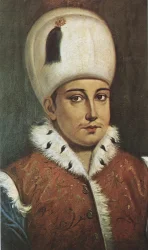
Mahmud II
Mahmud II was born in Constantinople on 20 July 1785, a son of Sultan Abdülhamid I. He ruled the Ottoman Empire from 1808 until his death in 1839, a period marked by rebellions, territorial losses and an ambitious effort to rebuild the authority of the central state. His reign laid important groundwork for the sweeping reforms that followed.
A Turbulent Accession
Mahmud came to the throne after a military uprising toppled his brother Mustafa IV. The revolt’s leader, Alemdar Mustafa Pasha, brought Mahmud to power and became grand vizier. In 1808, Mahmud’s government negotiated the Sened-i İttifak, an agreement with powerful provincial notables that attempted to define their relationship with the central government. Alemdar was killed during a Janissary revolt later that year, and Mahmud spent much of the next decade consolidating his position.
The empire faced wars on several fronts. The 1812 Treaty of Bucharest ended a conflict with Russia, while uprisings in Serbia and Greece challenged Ottoman rule. Mahmud eventually recognized greater Serbian autonomy. The Greek revolt, which began in 1821, drew in Egypt’s powerful ruler Muhammad Ali and ended with Greece’s independence, established through international agreements in 1830 and 1832.
Breaking with the Janissaries
The Janissary corps had long been a major force in Ottoman politics and military affairs. After earlier attempts at military reform faltered, Mahmud prepared to replace it with a disciplined army trained along European lines. When the Janissaries revolted in June 1826, he crushed the uprising and abolished the corps in an episode remembered as the Auspicious Incident. The confrontation killed many Janissaries, but it removed a powerful barrier to military change.
Mahmud established the Asakir-i Mansure-i Muhammediye, or Victorious Soldiers of Muhammad, as a new army. He also reorganized government offices, expanded state schooling and medical training, introduced new dress rules, and founded the official newspaper Takvim-i Vekayi in 1831. These changes strengthened the government’s reach and altered public institutions, though their implementation was uneven.
War, Reform and Legacy
The empire’s international position remained precarious. Russia’s 1828–29 war forced Mahmud to accept the Treaty of Adrianople, while Egyptian forces under Muhammad Ali’s son Ibrahim Pasha later defeated Ottoman armies in Syria and Anatolia. Mahmud sought outside support and continued to push for a stronger, more centralized state. The last of these conflicts was still unfolding when he died on 30 June 1839.
His son Abdülmecid I succeeded him. In November 1839, the new sultan’s government proclaimed the Gülhane Edict, launching the Tanzimat era of reform. Issued after Mahmud’s death, it built on the centralizing and modernizing work of his reign. Mahmud left an empire weakened by war and revolt, but with institutions and a new army that would shape its later transformation.