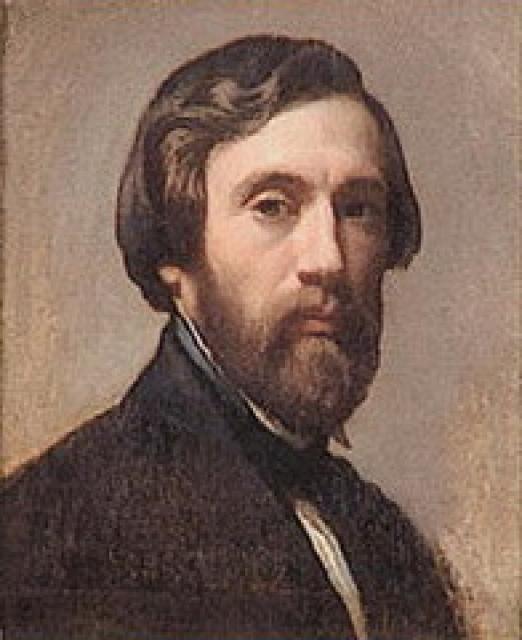
Marc Gabriel Charles Gleyre
 France
- Charles Gleyre: An Uncompromising Visionary
- Wanderings and Artistic Awakening
- Return to Paris and Critical Acclaim
- Unwavering Commitment to Artistic Excellence
- Notable Masterpieces and Antiqued Themes
- Renowned Educator and Mentor
Charles Gleyre: An Uncompromising Visionary
Early Life and Artistic DevelopmentBorn into poverty in Switzerland, Charles Gleyre lost his parents at a young age. At the age of eight or nine, he was taken to Lyon by his uncle and placed in a factory school. In the mid-1820s, he embarked on a journey to Paris, where he spent several years diligently studying painting.
Wanderings and Artistic Awakening
After leaving Paris, Gleyre embarked on a decade-long journey that took him through Italy, Greece, Egypt, Lebanon, and Syria. These travels exposed him to the works of renowned artists such as Horace Vernet and Louis-Léopold Robert, profoundly shaping his artistic perspective.
Return to Paris and Critical Acclaim
Returning to Paris in the late 1830s, Gleyre immersed himself in his work. His first significant painting, "Vision of Saint John," garnered attention in 1840. This was followed by his monumental allegory "Evening" (1843), which earned a silver medal at the Paris Exhibition and became known as "Lost Illusions."
Unwavering Commitment to Artistic Excellence
Despite his initial success, Gleyre withdrew from competitive exhibitions. Meticulous and perfectionistic, he worked diligently on his paintings, producing a prodigious oeuvre of over 680 works, including études, drawings, and the famed portrait of Heinrich Heine featured in "Revue des Deux Mondes."
Notable Masterpieces and Antiqued Themes
Among Gleyre's most celebrated works are "Terrestrial Paradise," praised by Hippolyte Taine, "The Flood," "Odysseus and Nausicaä," and "The Prodigal Son." These canvases deftly blended antique and biblical themes with his distinctive academic style.
Renowned Educator and Mentor
Gleyre's influence extended beyond his own art. As an educator, he succeeded Paul Delaroche in the mid-1840s, guiding the careers of renowned artists such as Sisley, Renoir, Monet, and Whistler. His studio became a breeding ground for some of the most prominent painters of the era.