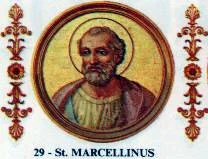
Marcellinus
Marcellinus was bishop of Rome during a dangerous turning point for early Christianity. He led the Roman church from 296 until about 304, just as Emperor Diocletian’s persecution brought new pressure on Christian communities. His pontificate is poorly documented, and later stories about his conduct under persecution remain disputed.
Bishop in an unsettled empire
Marcellinus became bishop of Rome in 296, succeeding Caius. The church was growing, but it remained a minority faith in an empire whose rulers expected public loyalty to traditional religious rites. For much of his tenure, Christians in Rome faced an uneasy peace. That changed in 303, when Diocletian issued edicts ordering the destruction of churches and scriptures and demanding participation in Roman religious ceremonies.
The persecution tested Christian communities across the empire. Records from Marcellinus’s own time are scarce, and the surviving sources provide little reliable detail about how he governed the Roman church. The persecution affected him personally, according to the historian Eusebius, but the meaning of that brief statement is unclear.
The controversy over apostasy
Later Christian writers accused Marcellinus of yielding to pressure and offering incense to the Roman gods. Other later accounts added a dramatic story in which he confessed his lapse before a council of bishops at Sinuessa and then died as a martyr. Historians have rejected the council’s supposed records as a forgery, and the story cannot be treated as a dependable account of what happened.
The accusation itself remains difficult to resolve. It circulated in Christian disputes generations later, while Augustine of Hippo argued that the charge was not established by documentary evidence. Modern accounts generally distinguish between the unreliable council story and the broader uncertainty about Marcellinus’s conduct during the persecution.
An uncertain death and a lasting question
Marcellinus died around 304, though the exact date and circumstances are uncertain. Reliable contemporary evidence does not clearly establish that he was executed or died as a martyr. His burial was associated with the cemetery of Priscilla on the Via Salaria, one of Rome’s important early Christian burial grounds.
The persecution severely disrupted church life in Rome. A successor was not chosen until 308, leaving a vacancy of several years. Marcellinus’s place in church history is therefore defined less by surviving records of policy than by the unanswered question of how a Christian leader responded when the state demanded public renunciation of his faith.
The stories about him show how later generations used the memory of persecution to debate courage, failure and repentance. Behind the legends stands a bishop whose short and poorly documented final years unfolded during one of the most severe crises faced by early Christians.