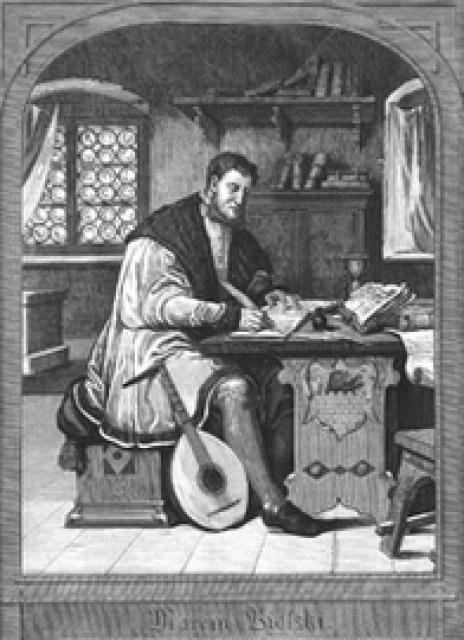
Marcin Bielski
 Poland
- Martin Bielski: A Renaissance Luminary
- Noble Lineage and Renaissance Roots
- Breaking Ground with Polish-Language Chronicles
- Literary and Historical Endeavors
- Legacy and Impact
- Final Resting Place
Martin Bielski: A Renaissance Luminary
IntroductionMartin Bielski (?-1575) was a prominent Polish writer, historian, and poet during the Renaissance era. His remarkable contributions to Polish literature and historiography continue to resonate to this day.
Noble Lineage and Renaissance Roots
Bielski hailed from a noble family of the Prawdzic clan. As a renowned warrior and man of letters, he embodied the ideals of Polish Renaissance chivalry. In 1540, Bielski married into a wealthy family and adopted the name of Biała Szlachęcka, after his wife's village.
Breaking Ground with Polish-Language Chronicles
Bielski's groundbreaking achievement was to write chronicles in Polish instead of the traditional Latin. His "Chronicle of the Entire World" (1551) marked the first comprehensive overview of world history in Polish literature. It saw three editions during his lifetime and profoundly influenced historiography in Eastern Europe.
Literary and Historical Endeavors
Beyond his chronicles, Bielski authored other notable works, including the "Chronicle of Poland" published posthumously by his son in 1597. He also penned Poland's first original morality play, "The Comedy of Justin and Constance" (1557).
Legacy and Impact
Bielski's writings not only provided a rich account of Polish and world history but also played a pivotal role in the development of Polish literature. His works influenced generations of writers and contributed to the flourishing of Polish Renaissance culture.
Final Resting Place
Martin Bielski passed away in 1575 and was laid to rest in the town of Pajęczno. His legacy continues to live on as a testament to his exceptional contributions to Polish Renaissance literature and historiography.