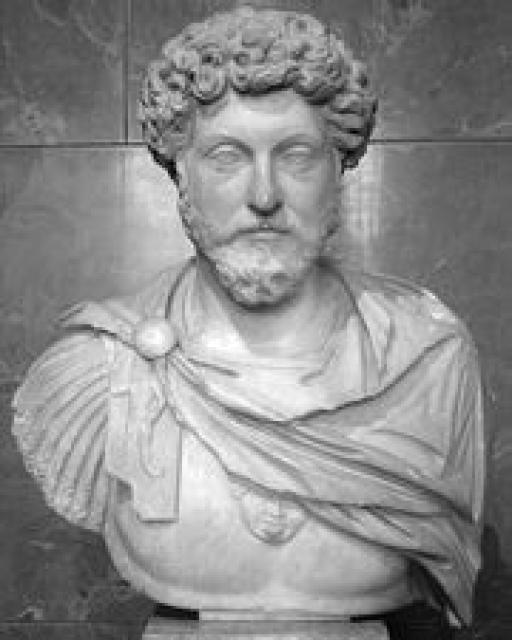
Marcus Aurelius
 Italy
ItalyBiography of Marcus Aurelius
Marcus Annius Catilius Severus, known as Marcus Aurelius, was a Roman emperor from the Antonine dynasty. He was born to Annia Verus and Domitia Lucilla. After the death of his father in 139 AD, he was adopted by Emperor Antoninus Pius and became known as Marcus Aelius Aurelius Verus Caesar. Marcus Aurelius received an excellent education, being introduced to philosophy by Diognetus and trained in painting. Under the influence of his philosophical teachings, he began sleeping on bare boards, covered with animal skins. While still young, Marcus, with the recommendation of his teacher, was appointed as a quaestor, and six months after the death of Emperor Hadrian, he assumed the position of quaestor (December 5, 138 AD), engaging in administrative activities.
In the same year, he became engaged to Faustina, the daughter of Emperor Antoninus Pius, Hadrian's successor. Pius designated him as consul for the year 140 AD and declared him Caesar. In 140 AD, Marcus became consul for the first time and in 145 AD, he became consul for the second time, together with Pius.
At the age of 25, Marcus turned his focus to philosophy. His main mentor in philosophy was Quintus Junius Rusticus. There is also information about other philosophers brought to Rome for Marcus. Famous jurist L. Volusius Maecianus served as Marcus' mentor in studying civil law. Antoninus Pius introduced Marcus Aurelius to the governance of the state in 146 AD, giving him the power of plebeian tribune. On January 1, 161 AD, Marcus entered his third consulship with his adoptive brother. In March of the same year, Emperor Antoninus Pius passed away, and the joint rule of Marcus Aurelius and Lucius Verus began, lasting until January 169 AD.
Marcus Aurelius learned a lot from his adoptive father Antoninus Pius. Like him, Marcus emphasized his respect for the Senate as an institution and for senators as its members. Marcus paid great attention to the administration of justice. The overall direction of his legal activities was to "reinstate ancient law" rather than introduce innovations. In Athens, he established four chairs of philosophy - one for each of the prevailing philosophical schools of his time - Academic, Peripatetic, Stoic, and Epicurean. Professors were given state funding.
Being a non-warlike individual, Marcus had to participate in military campaigns multiple times. Immediately after the death of Antoninus Pius, the Parthians invaded Roman territories and defeated the Roman army in two battles. The Roman Empire made peace with Parthia in 166 AD. In the same year, Germanic tribes invaded Roman territories along the Danube. The co-emperors launched a campaign against the barbarians. Before the war with the Germans and Sarmatians was finished, unrest began in Northern Egypt (172 AD).
In 178 AD, Marcus Aurelius led a campaign against the Germans and achieved great success, but the Roman army was hit by a plague outbreak. On March 17, 180 AD, Marcus Aurelius died from the plague in Vindobona on the Danube (modern-day Vienna). After his death, Marcus was officially deified. His reign is considered the golden age in ancient historical tradition. Marcus is called a philosopher on the throne. He adhered to the principles of Stoicism, and the main focus of his writings is ethical teachings, the evaluation of life from a philosophical-moral standpoint, and advice on how to approach life.
He left behind philosophical writings - 12 books written in Greek, commonly known as "Meditations." At the core of his anti-materialistic doctrine is the partial possession of the body, soul, and spirit by an individual, with a righteous, courageous, and reason-guided personality as the bearer (although only having control over the spirit), fostering a sense of duty and serving as the abode of an examining conscience. Through the spirit, all people participate in the divine and thereby create an ideal community that transcends all limitations. Marcus Aurelius tragically combined courage and disillusionment.


