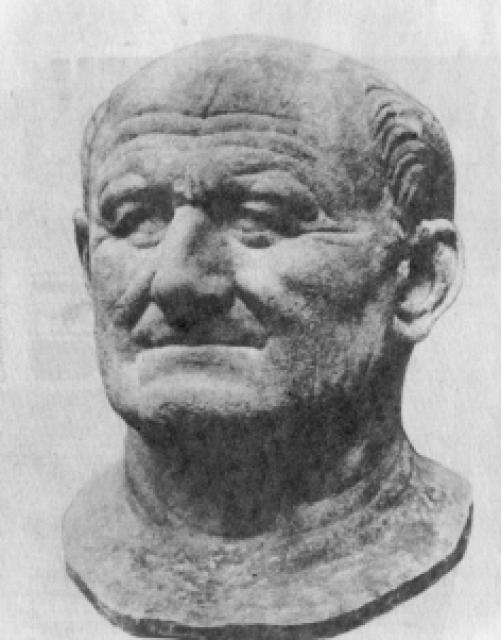
Vespasian
 Italy
ItalyBiography of Vespasian
Vespasian was a Roman emperor who ruled from 69 AD after the reign of Nero. He came from a humble Flavian family. His grandfather was a centurion or even a simple soldier in Pompey's army. After retiring, he amassed a fortune by collecting money from auctions. His father, who was a tax collector in Asia, also engaged in the same business. This not only brought him wealth but also fame - many cities erected statues in his honor with the inscription "To the Just Tax Collector." Vespasian's mother's side of the family was much more well-known, and Vespasian received his nickname from his maternal grandfather, Vespasianus Pollio, a three-time military tribune and camp commander.
In Antioch, Vespasian took command of the army and gathered auxiliary troops from all over. He began his campaign in 67 AD, realizing that it would be a grueling and dangerous undertaking. The Jews did not risk fighting the legions in open field but instead took cover behind the walls of cities and defended themselves with great determination. The Romans first invaded Galilee from Ptolemais and, after a difficult siege, took the well-fortified city of Jotapata. All its inhabitants were slaughtered. Jaffa was captured immediately, and Tiberias surrendered without a fight. The people of Tarichea tried to resist, but their city was taken on the first assault. At first, Vespasian promised the prisoners life and freedom, but he changed his mind. He sent all the Jewish immigrants to Tiberias, executed around a thousand, and sold another forty thousand into slavery.
The city of Gamala, located nearby, defended itself with desperate persistence. After finally capturing the city, the Romans even killed infants. After this, all of Galilee recognized Roman rule. This campaign brought Vespasian great fame and popularity in the army. Indeed, in the very first battles, he showed exceptional bravery. During the siege of Jotapata, he was wounded in the knee by a stone and had several arrows stuck in his shield. During marches, Vespasian usually walked ahead of the troops, skillfully chose a place for the camp, thought day and night about the victory over the enemies, and, if necessary, struck them with a mighty hand. He ate whatever was available, and his clothing and habits differed little from those of an ordinary soldier - in short, if it weren't for his greed, he could have been considered a Roman general of ancient times.
Meanwhile, in 68 AD, news of unrest in Gaul and the defection of Vindex with local leaders from Nero reached Vespasian. This news prompted Vespasian to hasten the end of the war, as he already foresaw future civil strife and the dangerous situation of the entire state. He believed that he would be able to free Italy from horrors if he first established peace in the East. In the spring, he moved along the Jordan River and set up camp near Jericho. From there, he sent troops in different directions and conquered all the surrounding cities and villages. He was ready to begin the siege of Jerusalem when he learned of Nero's suicide. Vespasian then changed his tactics and delayed his advance, waiting to see how events would unfold. Overwhelmed by the state of the whole empire and the impending turmoil in Rome, he paid less attention to the war with the Jews and, deeply concerned about the fate of his own homeland, considered attacking others untimely.
Meanwhile, a civil war erupted in Italy. The proclaimed emperor Galba was openly killed in the Roman Forum, and Otho was proclaimed emperor in his place. Otho, in turn, fought against Vitellius and, defeated by him, took his own life. In April 69 AD, Vitellius became emperor. Vespasian consistently recognized all three emperors and, with each change of power, had his legions swear allegiance to the new princeps. Although he knew how to obey as well as command, news of the excesses of the Vitellians in Rome made him furious. He despised Vitellius and considered him unworthy of the throne. While he was filled with the most painful thoughts, he felt the burden of his position as a conqueror of foreign lands while his own homeland was perishing. But the fact that he was far from Rome and the power of the Germanic legions, on which Vitellius relied, kept him restrained. Meanwhile, military commanders and soldiers openly discussed changing the government, and the demand to proclaim Vespasian emperor grew louder. On July 1, 69 AD, the legions in Alexandria swore allegiance to Vespasian. As soon as the news reached Judea, the soldiers who gathered at Vespasian's tent greeted him joyfully as emperor. Right there, at the gathering, he was bestowed with the titles of Caesar, Augustus, and all other names befitting a princeps. Vespasian remained the same as before in these new and unusual circumstances - unimportant, without any arrogance. He addressed the troops with a few simple and stern words. In response, loud cheers of rejoicing and loyalty erupted from all sides. The joyful uprising also spread to the legions stationed in Syria. Lucius Mucianus, who commanded them, immediately had them swear allegiance to Vespasian. Even before the Ides of July, all of Syria swore loyalty to the new emperor.
Vespasian began preparing for war by recruiting and calling veterans into the army. The most well-to-do cities were tasked with setting up weapon workshops, and gold and silver coins were minted in Antioch. These measures were urgently carried out by trusted individuals on the ground. Vespasian appeared everywhere, encouraging everyone, praising honest and active people, instructing the confused and weak with his own example, and occasionally resorting to punishment. He appointed prefects and procurators to various positions and appointed new members to the Senate, mostly outstanding individuals who soon held high positions in the state.
Regarding the soldiers' monetary reward, it was announced at the first gathering that it would be modest, and Vespasian promised the troops no more than what they were paid for peacetime service. He was an opponent of senseless generosity towards soldiers, and therefore his army was always better than others. Legates were sent to Parthia and Armenia, and measures were taken to ensure that the borders would not be left defenseless after the legions left for the civil war. His son Titus stayed in Judea, and he himself decided to go to Egypt. It was decided that only part of the troops and a commander like Mucianus, as well as the glory surrounding Vespasian's name, would be enough to defeat Vitellius.
So, Mucianus set off for Italy, and Vespasian sailed to Egypt. He considered it of paramount importance to secure this province because, firstly, it allowed him to control the supply of grain to Rome, and secondly, it provided him with a place to retreat in case of defeat. Titus was entrusted with finishing the Jewish War, and in 71 AD, a triumph was celebrated. During Vespasian's reign, Achaia, Lycia, Rhodes, Byzantium, and Samos were again deprived of their freedom, and the mountainous Cilicia and Commagene, previously under the rule of kings, were turned into provinces.
From the first days of his rule until his death, Vespasian was accessible and approachable. He never hid his lowly origins and often even displayed them. He never sought external splendor, and even on the day of his triumph, exhausted by the slow and exhausting procession, he could not help but say, "Alas, I seem to be becoming a god." He tried to get up, saying that an emperor should die standing, and passed away supported by those who held him. All the monarchs of the world. Ancient Greece. Ancient Rome. Byzantium. Konstantin Ryzhov. Moscow, 2001.


