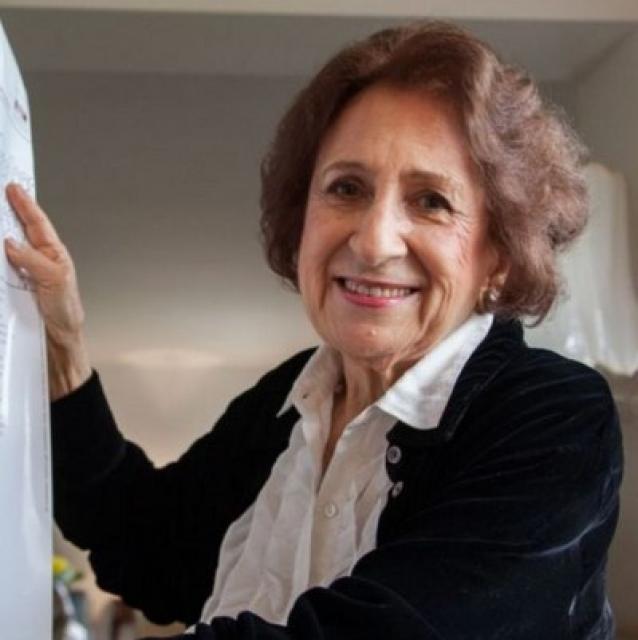
Margot Benacerraf
 Venezuela
- Early Life and Education
- Documentary Filmmaking
- "Araya" and International Recognition
- Cultural Advocacy and Institution Building
- Support for Latin American Cinema
Early Life and Education
María Benacerraf, a Venezuelan filmmaker, screenwriter, producer, and art historian, was a significant figure in Latin American cinema. Born in Spanish Morocco of Sephardic origin, Benacerraf pursued her studies in philosophy and the humanities at the Central University of Venezuela (UCV). During this period, she began publishing essays and plays that garnered recognition both in Venezuela and internationally.
In 1949, Benacerraf was invited by Columbia University to New York City, where she studied drama under the renowned German theater director Erwin Piscator. It was during this time in New York that she discovered cinema and filmmaking. She received specialized training in Paris at the prestigious film school, Institut des hautes études cinématographiques (IDHEC).
Documentary Filmmaking
As a documentary filmmaker, Benacerraf directed several short films. Two of her most acclaimed works were "Reverón" (1952), which explored the life of the Venezuelan artist Armando Reverón, and "Araya" (1959), which depicted the lives of workers in the Araya salt mines in northern Venezuela.
"Araya" and International Recognition
"Araya" was presented at the 1959 Cannes International Film Festival, where it received the International Federation of Film Critics (FIPRESCI) Prize along with Alain Resnais' "Hiroshima mon amour." Renowned filmmakers such as Luis Buñuel, Roberto Rossellini, and Glauber Rocha praised Benacerraf's cinematic work, while writers Miguel Otero Silva and Gabriel García Márquez expressed their desire for her to adapt their literary works into films.
Cultural Advocacy and Institution Building
In 1965, Benacerraf was appointed director of Venezuela's INCIBA (National Institute of Culture and the Arts), the country's foremost cultural institution. She emphasized bringing cultural and educational programs to isolated regions. In 1966, she founded the Venezuelan National Film Archive (Cinemateca Nacional de Venezuela) and served as its director for three years. She was also instrumental in establishing the Union of Latin American Film Archives (UCAL). Subsequently, she became a member of the organizing committee for the cultural center Ateneo de Caracas.
Support for Latin American Cinema
With the support of Nobel laureate writer and patron of Latin American cinema Gabriel García Márquez, Benacerraf established Latin Fundavisual in 1991. This foundation aimed to promote Latin American audiovisual cinema in Venezuela. Benacerraf was one of two recipients of the Paez Art Medal in 2019 from the Venezuelan Association of Visual Arts Experts (VAEA).


