Margrethe Mather
 USA
- Early Life and Career
- Partnership with Edward Weston
- Photographic Work and Recognition
- Later Years and Legacy
Margrethe Mather helped reshape American photography at a moment when the medium was moving away from painterly imitation and toward modernist clarity. Her portraits and carefully structured compositions made her a distinctive artist in her own right, even as her long creative partnership with Edward Weston later drew much of the attention.
Early Life and Career
Born in 1886, Mather grew up to become a self-taught photographer. She adopted the name Margrethe Mather early in adulthood and made her way to Southern California, where she entered the region’s artistic circles. By 1916 she was advertising her services as a photographer, building a practice that included portraits and images for interior designers.
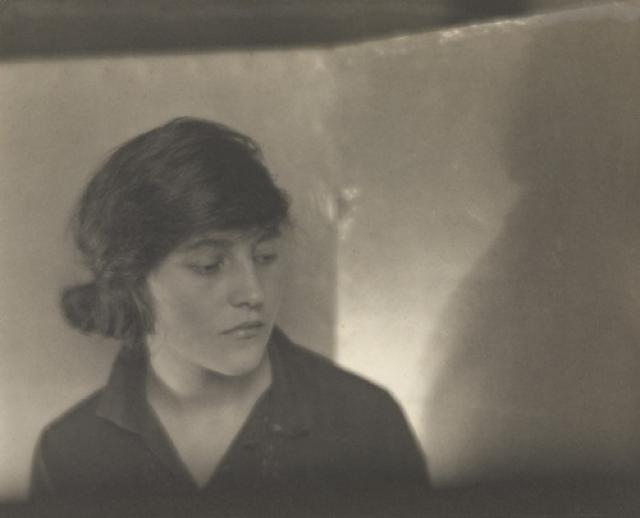
Mather first worked in the pictorialist tradition, which often gave photographs the soft, atmospheric quality of drawings or paintings. She gradually developed a more modern approach, using precise composition, unexpected cropping, strong contrasts, and shadow to make the camera’s own visual language the focus.
Partnership with Edward Weston
Mather met Weston in California in 1913, beginning a close personal and artistic relationship that lasted for about twelve years. She introduced him to a bohemian circle of artists and writers and shared ideas that helped shape his development. They also worked together in his Glendale studio, where Mather contributed as a photographer, business partner, and collaborator.
In 1914 they helped establish the Camera Pictorialists of Los Angeles, a group that became an important venue for exhibitions and debate. Their work evolved beyond conventional pictorialism. For a period, they signed some photographs jointly, an unusual arrangement in Weston’s career that reflected the genuinely shared nature of their experiments. Their relationship eventually shifted toward friendship and professional respect, while Mather’s own reputation was increasingly overshadowed by his.
Photographic Work and Recognition
Mather’s photographs show a keen interest in form, texture, and the expressive possibilities of a sitter or setting. “The Stairway” brought attention to her work, while her portraits of actor Reginald Pole, including images associated with his role as Othello, demonstrated her skill at using light and shadow to create character. Her portrait of Chinese American artist Moon Kwan was also admired for its fresh, unconventional treatment.
She exhibited widely and appeared in photography journals including Camera Craft and American Photography. In 1931, with artist William Justema, she organized “Patterns by Photography” at San Francisco’s M. H. de Young Memorial Museum. The exhibition presented photography as a source of striking patterns and forms, a perspective that reflected her modernist interests.
Later Years and Legacy
Mather’s substantial photographic output declined in the early 1930s. She was diagnosed with multiple sclerosis in 1939 and died in California in 1952. Her career was relatively short, but its influence was significant: she helped move West Coast photography toward modernism and produced an independent body of portraits and compositions that merits attention on its own.