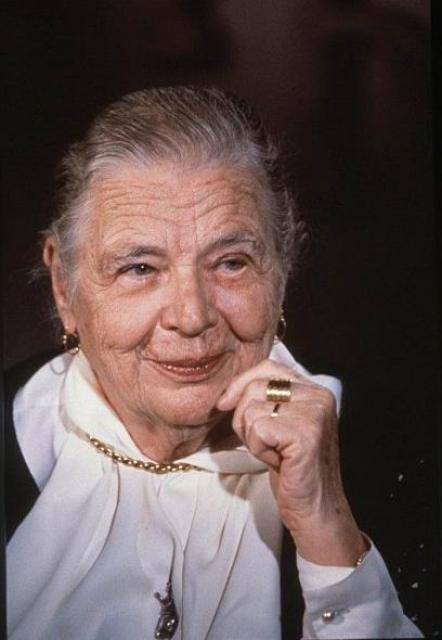
Marguerite Yursenar
 France
- Marguerite Yourcenar, the Trailblazing French Writer
- A Unique Upbringing
- Early Literary Experiments
- Scandal and Independence
- The War and Exile
- A Literary Legacy
- Breaking Barriers
- Love and Feminism
- Nature's Advocate
- Passing and Legacy
Marguerite Yourcenar, the Trailblazing French Writer
A Pioneer in Literature and LifeMarguerite Yourcenar (1903-1987) was a groundbreaking French writer who shattered two-centuries of tradition by becoming the first woman inducted into the prestigious Académie française (French Academy). Throughout her life and work, she forged her own path, defying societal norms and challenging literary conventions.
A Unique Upbringing
Born in Belgium to a noble Belgian mother, Yourcenar's early life was shaped by her bohemian father, Michel de Crayencour. A wanderer and lover of art, he instilled in his daughter a deep appreciation for literature. Despite receiving no formal education, Yourcenar acquired an extensive knowledge of multiple languages and a voracious intellect that she cultivated throughout her life.
Early Literary Experiments
Yourcenar's literary career began with the publication of "Le Jardin des Chimères" (1921), a poem written under the pseudonym Marguerite Yourcenar, an anagram of her father's surname. In 1929, she made her debut in prose with "Alexis, ou le Traité du vain combat," a controversial exploration of homosexuality.
Scandal and Independence
Yourcenar's choice of subjects in her early works reflected her independent spirit and disregard for societal expectations. She continued to question societal norms and explore themes of sexual freedom and identity throughout her writings.
The War and Exile
The outbreak of World War II profoundly affected Yourcenar. She left France for the United States in 1939, accompanied by her close friend and translator, Grace Frick. She remained in America for the rest of her life, becoming an American citizen in 1947.
A Literary Legacy
In the decades following the war, Yourcenar produced her most acclaimed works, including "Mémoires d'Hadrien" (1951), a historical novel about the Roman emperor Hadrian. Her writing was widely recognized for its erudition, philosophical depth, and exquisite prose.
Breaking Barriers
In 1981, Yourcenar was elected to the Académie française, a momentous event that signaled a shift in attitudes towards women in French society. Her acceptance speech challenged the academy's historical exclusion of female members with wit and irony.
Love and Feminism
Yourcenar placed great importance on love in all its forms, believing it to be a sacred and transformative force. She actively supported the struggle for gender equality, but opposed the "aggressive feminism" of some movements.
Nature's Advocate
Conservation and environmentalism were also close to Yourcenar's heart. She sought to raise awareness of the importance of wildlife and the preservation of the natural world.
Passing and Legacy
Marguerite Yourcenar died in her home on Mount Desert Island in 1987, surrounded by her French friends. Her last words, spoken in the language she had loved all her life, were the sounds of her native French.
Yourcenar's enduring legacy includes her groundbreaking literary achievements, her unwavering commitment to intellectual freedom, and her advocacy for a more just and equitable world.


