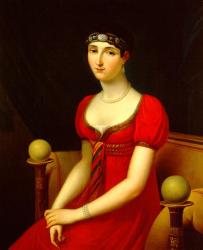
Marie Paulette Bonaparte
 France
- Early Life and the Bonaparte Family
- Marriage to Charles Leclerc
- Princess Borghese and “Venus Victrix”
- Napoleon’s Fall and Exile
- Legacy
Maria Paola “Pauline” Bonaparte was a younger sister of Napoleon Bonaparte and one of the most prominent women of the imperial family. Known for her beauty, social confidence and vivid public image, she moved through the upheavals of the French Revolution, Napoleon’s rise and his fall. Her life included two politically significant marriages, a journey to Saint-Domingue during the Haitian Revolution, and a much-celebrated portrait as Venus by sculptor Antonio Canova.
Early Life and the Bonaparte Family
Pauline was born in Ajaccio, Corsica, on October 20, 1780, the daughter of Carlo Buonaparte and Letizia Ramolino. Her birth name is also recorded as Maria Paola. The family left Corsica after the island’s political situation shifted during the French Revolution and settled in mainland France. Her brother Napoleon’s military and political ascent transformed the family’s fortunes and brought her into the center of European court life.
Pauline was known for her closeness to Napoleon, who was protective of her and took an active role in shaping her marriages and public position. She was also noted by contemporaries for her social ease and love of luxury. Portraits and later biographies often emphasized her beauty, sometimes reducing her reputation to it, but her life was also closely tied to the political calculations and family obligations of the Bonaparte era.
Marriage to Charles Leclerc
In 1797, at Napoleon’s direction, Pauline married General Charles Leclerc, one of his trusted officers. They had a son, Napoléon Dermide Leclerc, born in 1798. In 1801 Napoleon appointed Leclerc to lead a French expedition to Saint-Domingue, and Pauline accompanied him to the Caribbean with their young child.
The expedition was sent to reassert French control over the colony amid the Haitian Revolution, a struggle led by formerly enslaved people and their allies against slavery and colonial rule. French forces fought resistance led by Toussaint Louverture and other Haitian leaders. The campaign was brutal and ultimately failed to restore lasting French authority. Leclerc died of yellow fever in November 1802. Pauline returned to France with her son and her husband’s remains. Dermide died in 1804, a personal loss that marked her early family life.
Princess Borghese and “Venus Victrix”
In 1803, Pauline married Camillo Borghese, a wealthy Roman prince whose family’s status helped strengthen Napoleon’s political ties in Italy. The match brought her the title of Princess Borghese and access to the family’s collections and properties. Napoleon later made her Duchess of Guastalla, though the title and duchy were short-lived.
Pauline’s second marriage soon became unhappy, and she and Camillo lived apart for many years. Yet it produced one of the most enduring images of her. In 1804, Camillo commissioned Antonio Canova to sculpt Pauline as Venus Victrix, the victorious goddess of love. The marble figure shows her reclining with the apple associated with the Judgment of Paris. Completed in 1808, the sculpture became famous for its classical elegance and the striking decision to portray a living princess in a mythological, semi-nude guise.
The sculpture remains one of the best-known portraits of a member of the Bonaparte family. It reflects Pauline’s cultivated public image and the cultural ambitions of the Borghese household, while also capturing how her likeness could become a political and social symbol.
Napoleon’s Fall and Exile
After Napoleon’s first abdication in 1814, Pauline went to Elba, where he had been exiled. She was the only one of his siblings to visit him there and helped support his reduced household. When Napoleon returned to France in 1815, she left the island and eventually settled in Rome. After his defeat at Waterloo and exile to Saint Helena, she continued to advocate for her brother and sought permission to join him, though she never did.
Pauline spent her later years moving between Rome and Florence. She and Camillo remained separated for much of their marriage, but she later sought reconciliation and returned to live with him near the end of her life. Her health declined, and she died in Florence on June 9, 1825, aged 44. She was buried in Rome’s Basilica of Santa Maria Maggiore.
Legacy
Pauline’s historical reputation has often been shaped by stories about her beauty, relationships and extravagant lifestyle. Her own story, however, also reflects the political reach of the Bonaparte family: through marriage, titles, travel and loyalty to Napoleon, she was drawn into the central events of the French Empire. The Canova sculpture, her presence at Elba and her journey to Saint-Domingue have kept her visible in histories of Napoleon’s family and the culture of his age.