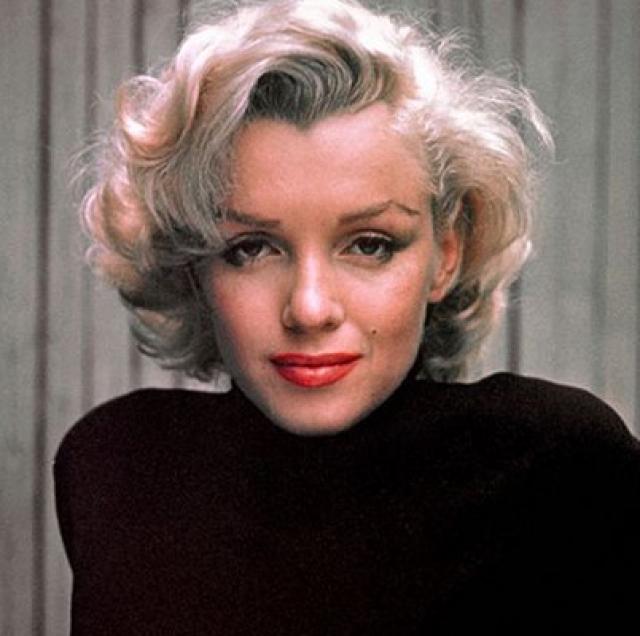
Marilyn Monroe
 USA
Marilyn Monroe became one of Hollywood’s most recognizable stars through a blend of comic timing, screen presence, and a carefully shaped public image. Behind the familiar glamour was an ambitious performer who sought greater control over her work and took acting seriously. In a career that lasted little more than a decade, she appeared in films ranging from Niagara and Gentlemen Prefer Blondes to Some Like It Hot and The Misfits.
Early life and a new name
Born Norma Jeane Mortenson in Los Angeles on 1 June 1926, she spent much of her childhood in foster homes and an orphanage as her mother struggled to care for her. As a young woman, she worked in a factory during World War II, where a photographer noticed her and helped open the door to modeling. She began appearing in magazines, then signed a film contract with Twentieth Century-Fox in 1946. Around this time, she adopted the professional name Marilyn Monroe.
After small roles in the late 1940s, Monroe attracted attention in John Huston’s crime drama The Asphalt Jungle and Joseph L. Mankiewicz’s All About Eve, both released in 1950. Her profile rose quickly. By the early 1950s she was taking leading roles, and the thriller Niagara (1953) and comedies Gentlemen Prefer Blondes and How to Marry a Millionaire established her as a major star.
Star power and creative ambition
Monroe’s comic performance as Sugar Kane in Billy Wilder’s Some Like It Hot (1959), alongside Jack Lemmon and Tony Curtis, became one of her signature roles and earned her a Golden Globe. She also showed a more dramatic side in Bus Stop (1956), playing a nightclub singer opposite Don Murray, and in The Misfits (1961), written by her then-husband Arthur Miller.
Frustrated by the roles and terms offered by the studio system, she founded Marilyn Monroe Productions with photographer Milton Greene in 1955. After negotiating a new agreement with Fox, she gained more say over her projects. The company produced Bus Stop and The Prince and the Showgirl (1957), which she made with Laurence Olivier. She also studied at the Actors Studio in New York, reflecting her determination to develop as a performer beyond the “dumb blonde” image often attached to her.
A lasting screen presence
Monroe’s private life, including marriages to James Dougherty, baseball star Joe DiMaggio, and playwright Arthur Miller, drew intense public attention. Yet her influence rests just as strongly on her work: an expressive screen persona that could turn vulnerability, sensuality, and wit into memorable performances. She died in 1962 at the age of 36, while work on the unfinished film Something’s Got to Give was still underway. Her brief career and carefully constructed image have continued to shape popular culture, photography, fashion, and the history of screen acting.


