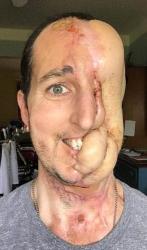
Mark Steadman
 Great Britain
Early Life and Diagnosis
Mark Steadman, a 38-year-old British man, had been plagued by excruciating facial pain for years. The relentless stabbing pain originated from his trigeminal nerve, a major nerve in the head. Initially, his pain was attributed to teeth grinding, but his wife dismissed this assumption. It took several doctor visits before he received a definitive diagnosis of trigeminal neuralgia.
Despair and Pain
Trigeminal neuralgia is an enigmatic condition that can strike anytime, triggering intense shocks of pain. A quarter of sufferers attempt suicide due to the intolerable agony. Steadman's life became a living nightmare as the pain intensified, making even simple tasks like brushing his teeth impossible. Despite heavy doses of medication, the pain persisted, leaving him in a constant state of despair.
A Drastic Solution
British doctors offered Steadman a groundbreaking solution: a partial craniectomy, or the removal of a section of his skull. Desperate for relief, Steadman agreed. On September 3, 2013, surgeons at Queen Elizabeth Hospital in Birmingham performed the six-hour procedure, excising a portion of his lower skull bone.
A New Life
The surgery was a success, providing Steadman with much-needed pain relief. He compared the pain before the operation to being electrocuted in the face, with up to 250 spasms per day. Now, he experiences a remarkable change in his life. The first kiss he shared with his wife after the surgery brought him immense joy, something he had been deprived of for four years.
Post-Surgery Recovery
Steadman now bears a small scar behind his right ear, a testament to the life-altering surgery. While the condition remains incurable, he cherishes every pain-free day, valuing the simple pleasures of life. Trigeminal neuralgia is often referred to as the "suicide disease," but Steadman's story proves that there is hope beyond the pain.