Martha Modl
 Germany
- Biography of Martha Mödl
- Early Life and Career
- Rise to Stardom
- Bayreuth Festival and International Recognition
- Notable Roles and Legacy
Biography of Martha Mödl
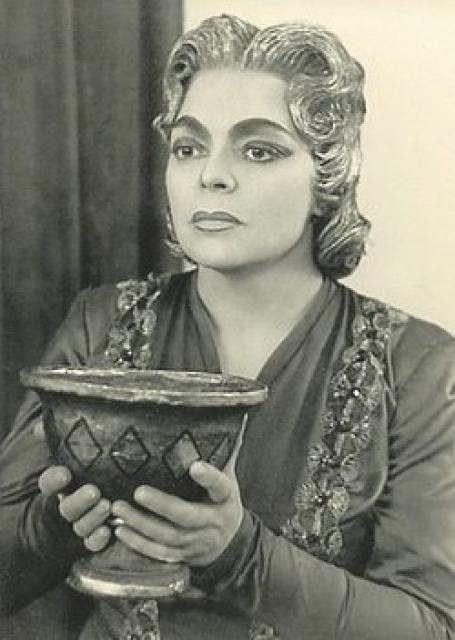
Martha Mödl was a German singer, known for her remarkable Wagnerian performances in the second half of the 20th century. Alongside Birgit Nilsson and Astrid Varnay, she was considered one of the most outstanding Wagnerian sopranos and mezzo-sopranos of her time.
Early Life and Career
Mödl initially worked as an accountant before enrolling at the Nuremberg Conservatory. Her debut as an opera singer came relatively late, in 1943, at the theater in Remscheid, where she performed the role of Hansel in Engelbert Humperdinck's opera "Hansel and Gretel." From 1945 to 1949, she worked in Düsseldorf, where she primarily sang mezzo-soprano roles such as Carmen in Bizet's "Carmen" and Cherubino in Mozart's "The Marriage of Figaro."
Rise to Stardom
In 1948, Mödl made her first appearance at the Vienna State Opera, where she achieved success in roles such as Octavian in Richard Strauss' "Der Rosenkavalier," Marina Mnishek in Mussorgsky's "Boris Godunov," Eboli in Verdi's "Don Carlos," Jocasta in Stravinsky's "Oedipus Rex," Church Watchman in Janacek's "From the House of the Dead," Lady Macbeth in Verdi's "Macbeth," and more. From 1949, she performed at the Hamburg State Opera, gradually transitioning to dramatic soprano roles and establishing herself as a remarkable Wagnerian singer.
Bayreuth Festival and International Recognition
In 1951, Mödl was invited by Wieland Wagner to the first post-war Bayreuth Festival, marking the beginning of her annual performances at the festival until 1967. She made her Bayreuth debut as Kundry in Wagner's "Parsifal." Mödl also became a member of the Stuttgart State Opera in 1953 and performed at the Metropolitan Opera in New York City from 1956 to 1960. She toured extensively, appearing in leading opera houses worldwide.
Notable Roles and Legacy
Mödl's acclaimed performances included Isolde in Wagner's "Tristan und Isolde," Brünnhilde in Wagner's "Ring Cycle," Ortrud in Wagner's "Lohengrin," Leonore in Beethoven's "Fidelio," and many more. Although her upper notes were not considered perfect, she compensated with her dramatic interpretation and deep commitment to her roles. The legendary conductor Wilhelm Furtwängler highly esteemed Mödl's talent, as evidenced by their notable recordings of "Ring Cycle" and "Fidelio" in the 1950s.
In the mid-1960s, Mödl returned to mezzo-soprano and contralto roles. She successfully portrayed Clytemnestra in Strauss' "Elektra" at the Salzburg Festival in 1964-1965. Mödl bid farewell to Bayreuth with performances as Waltraute and Fricka. In this period, she also participated in premieres of contemporary operas. What is most remarkable about Mödl's career is her longevity as a performer. Even in her eighties, she continued to sing, taking on the role of the Old Countess in Tchaikovsky's "The Queen of Spades."
Martha Mödl's contribution to the world of opera is celebrated for her exceptional dramatic talents and her ability to bring depth and intensity to her performances. She will always be remembered as one of the great interpreters of Wagner's works.