Martin Houp
 Great Britain
- Biography of Martin Hope
- Impressions of Russia and Moscow
- Cultural Differences and Challenges
- Relations between Russia and the UK
- Learning from Each Other
- Understanding the British National Character
Biography of Martin Hope
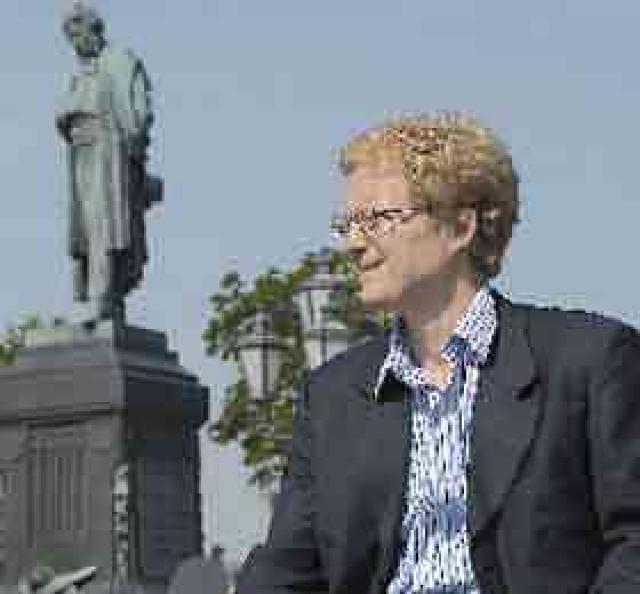
Martin Hope is the current director of the British Council in Moscow. He arrived in Moscow about a year ago and has already become familiar with the city. As the director of the British Council, he is able to observe and notice things that may go unnoticed by the locals or casual tourists.
Impressions of Russia and Moscow
When asked about what seemed the most unusual to him about life in Russia and Moscow, Martin mentioned the abundance of flower kiosks. He had never seen such a large number of flower kiosks anywhere else. He also found it intriguing how Russian men seemed to be either excessively romantic or constantly seeking forgiveness. Martin compared the number of flower kiosks to the number of theaters, indicating that it seemed like people in Russia spent a lot of their time going to see performances.
Martin also mentioned how there seemed to be constant celebrations in Russia. He had eaten numerous delicious pastries due to the frequent name days. He also described Moscow as a huge city that felt like a collection of small villages. He found it fascinating that small kiosks selling a variety of goods, from fruits to meat and stationery, were still present in Moscow, whereas in most countries they had been replaced by large supermarkets.
Cultural Differences and Challenges
Martin highlighted the cultural differences and challenges he faced in Russia. He mentioned the lack of automatic smiles from people, which was different from the programmed smiling behavior in England. He described how in England, if someone did not smile, it usually meant they were extremely dissatisfied, whereas in Russia, people were not programmed to smile automatically. He also mentioned the directness of Russian people, who would address unpleasant things immediately, while in England people often used colorful phrases to appear more diplomatic.
Relations between Russia and the UK
When discussing the current state of relations between Russia and the UK, Martin acknowledged that there was mutual distrust. He mentioned the quality of information about Russia in the British press, stating that it often left much to be desired. However, he mentioned a project being developed to organize meetings between young British and Russian journalists, in order to share experiences and improve the accuracy of their reporting.
Learning from Each Other
Martin expressed his belief that there is much to learn from Russia. He mentioned how Russian culture has influenced the world, particularly in the arts. He gave examples of the impact of Russian ballet, Diaghilev, and Chekhov on British culture. He also mentioned how Russian thinkers like Kropotkin had influenced radical thinkers in England, such as Ebenezer Howard and Patrick Geddes. He highlighted the popularity of Kropotkin in England and how his ideas had contributed to the development of the Green Party and the environmental movement.
Understanding the British National Character
Martin discussed the perceptions of the British national character. He acknowledged the common belief that the British are conservative, honest yet arrogant, and have isolationist tendencies. He also mentioned that the British, like the Russians, are not particularly proficient in foreign languages. Martin recognized the need to understand these national characteristics and the challenges they present.