Martin Rail
 Great Britain
- Martin Ryle - English Radio Astronomer
- Contributions to Radio Astronomy
- Aperture Synthesis Method
- Later Career and Legacy
Martin Ryle - English Radio Astronomer
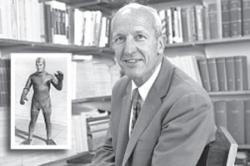
Martin Ryle was an English physicist and radio astronomer born in Oxford. He was the second of five children in the family of John Ryle, a physician and professor of social medicine at Oxford University, and Miriam (née Scally) Ryle. He studied at Bradfield College and Oxford University, where he graduated with honors from the School of Natural Sciences in 1939.
Contributions to Radio Astronomy
From 1939 to 1945, Ryle participated in the development and improvement of portable radar for military purposes and radio systems at the Telecommunications Research Establishment in Malvern, where he first met Anthony Hewish. In 1945, Ryle received a scholarship that allowed him to go to the Cavendish Laboratory at the University of Cambridge to conduct research under the supervision of John A. Ratcliffe and W.L. Bragg. His research focused on the emission of radio waves by the Sun, a phenomenon accidentally discovered during World War II by a radar operator. Ryle's equipment consisted of two small antennas.
After the war, Ryle remained in Cambridge, working at the Cavendish Laboratory and the Mullard Radio Astronomy Observatory. In 1948, he became a lecturer in physics at Trinity College, a member of the college staff in 1949, the second professor of physics in 1957, and the first professor of radio astronomy in 1959 at Cambridge. Ryle worked on improving the resolution of radio telescopes, which allows for distinguishing wavefronts from specific directions while disregarding wavefronts coming from neighboring directions.
Aperture Synthesis Method
Ryle's breakthrough came with the development of the aperture synthesis method. By placing two antennas at a distance of several wavelengths from each other, Ryle connected them to a single receiver. Using this interferometer setup, he discovered that radio waves emitted by solar spots originate from very small areas. By using phase shifts (combining signals from each antenna alternately in phase and out of phase), Ryle was able to distinguish radio waves emitted by the spot from radio waves emitted by the rest of the Sun. He applied the same method to search for stars and galaxies, reaching a distance of 6 billion light-years, three times further than the range of the 200-inch optical telescope at Mount Palomar. By 1948, he had determined the positions of several so-called radio stars (celestial objects emitting electromagnetic radiation) with enough accuracy to observe them with optical telescopes. The use of radio waves in astronomy opened up new areas of space for observation that were completely different from those observed with optical telescopes, such as regions containing high-energy particles or diffuse ionized gas.
In 1952, Ryle and his colleagues decided to create radio astronomical instruments that would not only observe weaker sources but also study their internal structure. Ryle discovered that it was theoretically possible to combine signals from two antennas (one of which is movable) with systematically changing distances and orientations between them. The necessary calculations could be performed on the computers available in the mid-1950s. In 1957, using the two-antenna telescope he built, Ryle surveyed a large portion of the sky, discovering 5000 radio sources. However, due to limited computational power, Ryle's telescope had high resolution in only one dimension. In 1963, using the significantly increased computational power of computers, Ryle built a three-antenna telescope, which allowed for high resolution in two dimensions, equivalent to a one-mile aperture radio telescope. With his telescope, Ryle was the first to demonstrate the capabilities of the aperture synthesis method, which achieves high resolution at a lower cost and without complex engineering structures. It was with the three-antenna telescope that the details of the structure of radio galaxies were first discovered.
Later Career and Legacy
In 1971, Ryle constructed a radio telescope with an even larger equivalent aperture (3.1 miles in diameter). The new telescope consisted of eight antennas, each with a diameter of 42 feet (four of which were mounted on mobile platforms), allowing for the study of the high-dispersion structure of distant radio sources. The resolution achieved with this telescope was equivalent to 0.6 inches. Ryle's extensive studies of radio sources, most of which were too distant and weak to be detected with optical telescopes, revealed that some of the most intense radio sources are quasars, distant star-like objects that emit many times more energy than entire galaxies. Modern radio telescopes, much larger than those built by Ryle and utilizing atomic clocks, can receive signals from antennas thousands of miles apart and process the received signals on a separate computer. The equivalent aperture of such a telescope is comparable to the diameter of the Earth.
In 1974, Ryle and Hewish were awarded the Nobel Prize in Physics "for their pioneering research in radio astrophysics." Ryle's prize was awarded specifically for his observations and inventions, particularly the aperture synthesis method. "The contributions of Ryle and Hewish are important steps in the development of our knowledge about the Universe," said Hans Wilhelmsson, a member of the Swedish Royal Academy of Sciences. "Thanks to their work, astrophysics has gained new areas of research. The giant laboratory of the Universe opens up its rich possibilities for future researchers."
Ryle's designed telescopes were built in the Netherlands and New Mexico. It is expected that very long baseline interferometry (with distances of several thousand kilometers) will allow for resolving structures as small as 0.001 inches. As demonstrated by Ryle's statistical analysis of radio sources, the Universe is not infinite and was once much hotter than it is now. His findings support the theory of the "Big Bang" in cosmology and are inconsistent with the steady-state theory.
In 1976, Ryle became actively involved in research on renewable energy sources, particularly wind and wave energy. His work showed that wind energy, taking into account large seasonal fluctuations in energy demand, could become a practical alternative to nuclear energy in the United Kingdom.
Ryle was married to nurse and physiotherapist Ella Rowena Palmer in 1947. The couple, along with their two daughters and son, enjoyed sailing on catamarans and trimarans designed by Ryle. He passed away from cancer in his home in Cambridge on October 16, 1984.
In 1966, Ryle received a knighthood. He was an honorary doctor of the University of Strathclyde, Oxford, and Toruń (Poland). From 1972 to 1982, he held the position of Astronomer Royal, a post traditionally held by the director of the Royal Greenwich Observatory. Ryle was a member of the Soviet Academy of Sciences, the Danish Academy of Sciences and Arts, the American Academy of Arts and Sciences, and the Royal Society of London. In addition to the Nobel Prize, he received numerous awards, including the Hughes Medal (1954) and the Royal Medal of the Royal Society (1973).