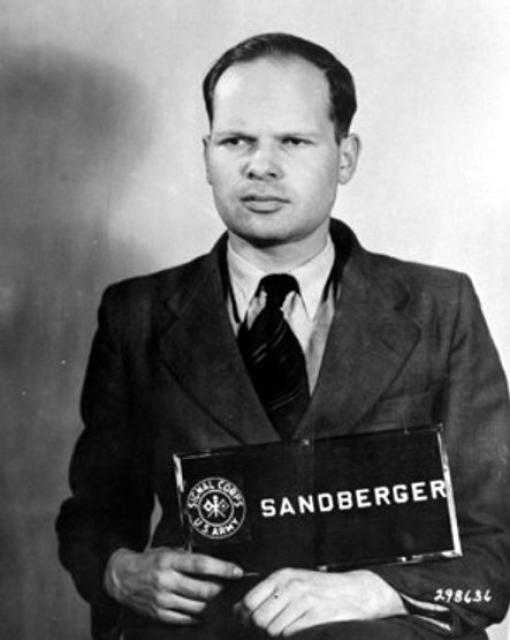
Martin Sandberger
 Germany
Biography of Martin Sandberger
Martin Sandberger was a high-ranking SS officer and commander of Einsatzkommando 1a. He was also the head of the main security police (Sipo) and security service (SD) in Estonia, and played a key role in the extermination of Jews in the Baltic States. He was the coordinator of the Estonian self-defense units known as "Omakaitse."
Early Life
Martin Sandberger was born in the Charlottenburg district of Berlin, Germany, into a family of I.G. Farben executives. He grew up in Berlin and Tübingen, and studied law at the universities of Munich, Cologne, Freiburg, and Tübingen. At the age of 20, he joined the Nazi Party (NSDAP) and the Sturmabteilung (SA). The influence of the National Socialists was already strong at the University of Tübingen even before they came to power. From 1932 to 1933, Sandberger was an active Nazi student activist and a leader of the student body in Tübingen. He graduated from the university with honors in 1933.
SS Career
As a member of the German National Socialist Student Union, Sandberger quickly rose through the ranks and became an inspector of elite schools within the Union. In 1936, he joined the SS and was recommended by Gustav Adolf Scheel to work in the SD in Württemberg. He also made rapid progress in the SD and by 1938, he was already an SS-Sturmbannführer.
War Crimes
On October 13, 1939, Heinrich Himmler appointed him as the chief of the northeastern immigration center, which was responsible for, among other tasks, "racial evaluation" of German repatriates. After the start of the war with the Soviet Union, Sandberger, as the leader of Einsatzkommando 1a, became one of the main perpetrators of mass killings in the Baltic States, along with another Tübingen lawyer, Dr. Walter Stahlecker. Sandberger showed particular zeal, and in the annual report as of July 1, 1942, he reported to Berlin about 941 Jews killed.
His efficiency was recognized, and on December 3, 1941, he was appointed as the commander of the Main Security Police and SD in Estonia. Sandberger is listed in the RSHA job register starting from March 1941 as the head of the department I B 3 (compilation of school curricula) and from January 1944 as an important unit VI A (organization of information services abroad) in the VI RSHA department. In the trial of the Einsatzgruppen in 1948, he was sentenced to death but later pardoned. His father, a retired director of an I.G. Farben factory, used his connections with Theodor Heuss, who then appealed to the former U.S. Ambassador James B. Conant for clemency.
Numerous respected citizens of Württemberg, such as Minister of Justice Wolfgang Hausmann, Bishop Martin Haug, and even respected lawyer and vice-president of the Bundestag Carlo Schmid, campaigned for Sandberger, who was serving his sentence in Landsberg Prison. As a result of such advocacy, Martin Sandberger was released on May 9, 1958.
Since August 2008, he has been the highest-ranking surviving SS officer.


