Mary Ann Kollo
 France
- Marie-Anne Collot: A Biography of the French Sculptor
- Success in Sculptural Portraiture
- Collaboration with Etienne Falconet
- Later Life
Marie-Anne Collot: A Biography of the French Sculptor
Marie-Anne Collot, a French sculptor and representative of Neoclassicism, began her artistic journey at a young age. Born in 1748, she started as a model in the workshop of sculptor Jean-Baptiste Lemoyne, who is believed to be her first teacher. At the age of 16, she became a student of Etienne Falconet, specializing in sculptural portraiture.
Success in Sculptural Portraiture
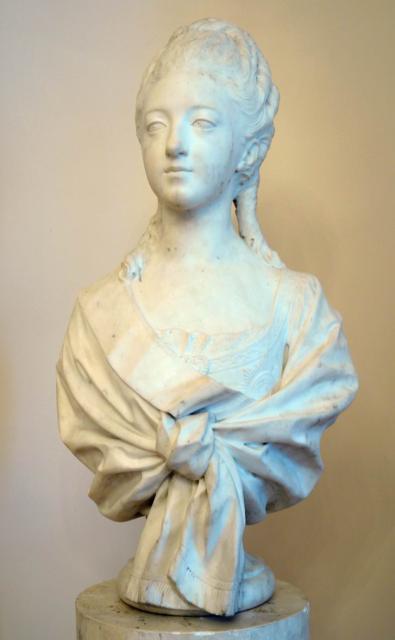
Collot's notable works in the field of portraiture include "Actor Preville as Scapin" (1765-1766), "Portrait of Diderot" (1766, Musée des monuments français, Paris), "Portrait of an Unknown" (1765, Louvre, Paris), and Prince Golitsyn (1766). Prince Golitsyn, a Russian ambassador in Paris, praised Collot's talent for portrait-making, describing her as a young apprentice with a specific talent. In 1766, Collot accompanied Etienne Falconet to St. Petersburg and lived and worked in Russia until 1778. During her time in Russia, she achieved success and completed several portrait medallions and busts, including a medallion of Count Grigory Orlov, the favorite of Empress Catherine II (1767, State Hermitage Museum, St. Petersburg), a medallion of Catherine II wearing a laurel wreath (1769, Gatchina Palace), and busts of Catherine II, Voltaire, and Diderot (1770-1773, State Hermitage Museum, St. Petersburg).
Collaboration with Etienne Falconet
One of Collot's most significant artistic achievements was her collaboration with Etienne Falconet on the equestrian statue of Peter the Great. She contributed to the creation of the portrait head of Peter the Great, using the posthumous mask made by Pietro Rotari. The original plaster model of this head is now preserved in the Russian Museum in St. Petersburg. Falconet considered Collot's contribution to this monument a great success. Impressed by Collot's talent, Empress Catherine awarded her a lifelong pension of 10,000 rubles and wished for her to be elected to the Academy of Arts.
Later Life
In addition to her collaboration with Falconet, Collot also executed other retrospective portraits commissioned by Catherine II, including busts of Henry IV and his minister Sully (1769). These works were created based on masks brought from Paris, with Collot relying more on her imagination. In 1777, Collot married Pierre Etienne Falconet's son, a painter, but the marriage was unhappy, marked by Collot filing an official complaint against her husband for ill-treatment. She left Paris in 1779 and continued to work alongside Falconet in the Netherlands. In The Hague, she created several portraits, including those of Stadtholder William V of Nassau and his wife Frederica Sophia Wilhelmina of Prussia (1782, Mauritshuis, The Hague). The reasons behind Collot's departure from sculpture remain unknown.
From 1783 to 1791, Collot resided in Paris, caring for her father-in-law who had suffered a stroke and was partially paralyzed. After the deaths of her husband and father-in-law in 1791, she moved to Lorraine and settled in Marimone.