Richard Serra
 USA
USABiography of Richard Serra
Richard Serra is an American sculptor and architect famous for his enormous metal sculptures - multi-ton, large-scale, and highly expressive. Each of his exhibitions, and even individual works, is a significant event in the world of contemporary art.
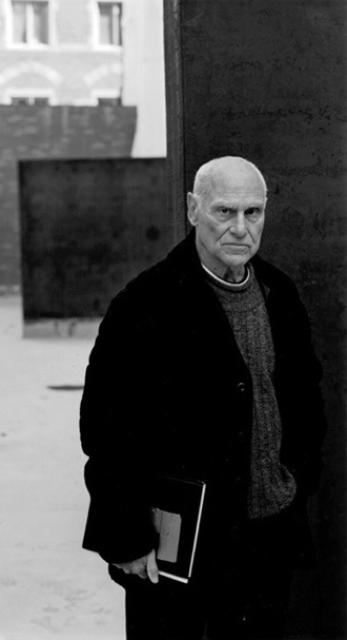
Richard Serra was born in 1939 in San Francisco. He studied English literature at the University of California, Berkeley and the University of California, Santa Barbara, before shifting his focus to the fine arts. In 1964, Serra graduated from Yale University, where he studied fine arts. He traveled extensively, living in North Africa, France, and Italy, as he searched for his artistic identity in painting and sculpture. Eventually, he settled in New York and began working with metal in the late 1960s.

Initially, Serra worked as a traditional sculptor, using materials such as steel, rubber, and lead. His first exhibition took place in Rome, Italy, in 1966. Despite finding his own unique method of expression, Serra continued to explore different artistic mediums, including printmaking and film in the early 1970s. It was during this time that he created his first large-scale steel compositions.
Today, Serra's works are displayed in many leading museums worldwide. For example, the Madrid Center of Arts of Queen Sofia showcases his composition 'Equal-Parallel-Guernica-Bengasi,' and the Guggenheim Museum in Bilbao features a sculptural group of eight enormous steel figures called 'The Matter of Time.' His sculpture 'Clara-Clara' can be found in the Place de la Concorde in Paris.
Serra's sculptures resemble architectural objects, with visitors able to enter these giant structures. The artist plans the routes and viewpoints for visitors, and the interior of his creations is designed to capture and record sounds. Serra often installs his sculptures near architectural structures and urban furniture, such as lampposts, benches, fountains, and buildings.
Despite the initial gleaming appearance of his sculptures, over time, they lose their original shine due to exposure to the elements. However, this fate befalls all outdoor compositions. Serra's gigantic steel creations, ranging in weight from a few tons to several hundred tons, can be found in Europe, America, and Japan.
In 2006, a notorious incident occurred when a 38-ton sculpture by Serra went missing from the Museum of Contemporary Art in Madrid. The museum only realized the artwork's disappearance 14 years after its vanishing.
Richard Serra is now recognized as a master and one of the most influential contemporary architects. His achievements are acknowledged not only for the size and uniqueness of his materials but also for his ability to shift the focus from the artworks themselves to the surrounding environment. Whether exhibited in a museum or a city square, the enigmatic and abstract nature of his creations inevitably permeates the surrounding space.
In 2010, Serra received the Prince of Asturias Award in the Arts category, often dubbed the "Spanish Nobel Prize." The award includes a prize of 50,000 euros, a statuette created by the Catalan artist Joan Miró, and a diploma. It recognizes Serra's extraordinary talents, significance, and contribution to the world of art, where artists have always fought for their vision of beauty and harmony, sometimes being misunderstood or unrecognized.
In 2010, the nominees for the Prince of Asturias Award in the Arts category included the Spanish director Carlos Saura and the Italian conductor Riccardo Muti. Previous winners of the award include figures such as directors Woody Allen and Pedro Almodóvar, musicians Paco de Lucía and Bob Dylan, and sculptor and artist Miquel Barceló.