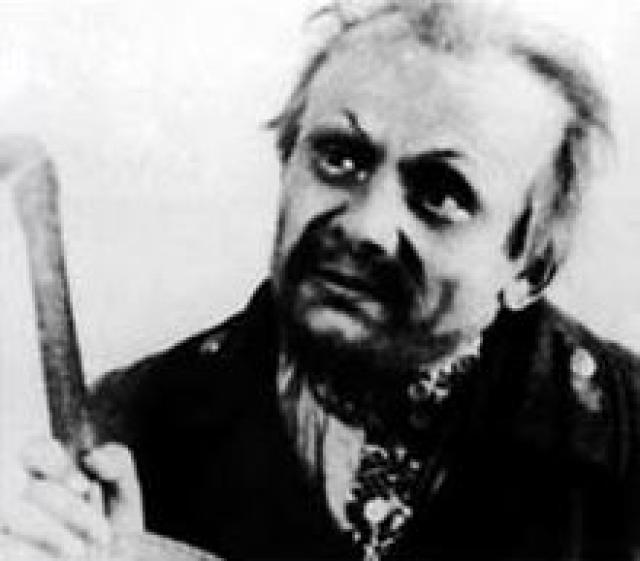
Maryan Kryshelnitskiy
 Ukraine
Marjan Krushelnytsky: A Pioneer of Ukrainian Theatre
Marjan Krushelnytsky was a Ukrainian Soviet theatre director and actor who played a pivotal role in shaping Ukrainian theatrical art in the 20th century. He was born into a modest family of Ukrainian peasants in the territory of Austro-Hungary. Krushelnytsky began his theatrical career in a semi-amateur Ukrainian theatre group called "Ternopil Evenings" from 1915 to 1917.
After the collapse of Austro-Hungary, he became one of the organizers of the New Theatre in Lviv in 1918, and later the Ukrainian Theatre named after Franko in Vinnytsia in 1920. From 1921 to 1923, he studied at the Faculty of Philosophy at Lviv University while working at the Lviv Ukrainian Theatre of the "Ruska Besida" society.
Following the closure of all Ukrainian cultural institutions in Poland in 1923, Krushelnytsky moved to Prague where he continued his studies at the Faculty of Philosophy at Prague University. After completing his university education in 1924, Krushelnytsky relocated to the USSR. In December 1924, he joined the Berezil Theatre in Kharkiv, which was led by Les Kurbas. It was at the Berezil Theatre where Krushelnytsky's rich talent flourished, first as an actor and later as a director.
After Kurbas' arrest and the destruction of Berezil in 1933, Krushelnytsky agreed to become the artistic director of the theatre, thus saving it from complete liquidation. In 1935, the theatre was transformed into the Ukrainian Shevchenko Drama Theatre, with Krushelnytsky serving as its head director and artistic director from 1935 to 1952.
In 1952, Krushelnytsky moved to Kyiv and joined the Ukrainian Franko Drama Theatre, where he served as the main director from 1954 to 1961. Throughout his career, Krushelnytsky portrayed numerous roles, including Abbé Honoré in "Jacquerie" by Mérimée (1925), Malakhii in "People's Malakhii" by Kulish (1928), Uncle Taras in "Myna Mazailo" by Kulish (1929), Sergeant Bednia in "Platzdarm" by Irchan (1932), and many others.
Apart from his work in the theatre, Krushelnytsky also dedicated himself to teaching. From 1932, he engaged in pedagogical activities and became a professor in 1947. He taught at the Kharkiv Theatre Institute from 1946 to 1952, and later at the Kyiv Theatre Institute from 1952 to 1964.
Krushelnytsky was honored with the title of People's Artist of the USSR in 1944, and he was a member of the Communist Party of the Soviet Union from 1943. He served as a deputy of the Supreme Soviet of the Ukrainian SSR from 1951 to 1959. Throughout his career, he received two Orders of Lenin, the Order of the Red Banner of Labor, and various medals.
Marjan Krushelnytsky passed away and was buried at the Baikove Cemetery in Kyiv, with a memorial plaque installed on the house where he once lived. Another memorial plaque was placed on the facade of the Ukrainian Shevchenko Drama Theatre in Kharkiv. In 1966, a street in Kyiv was named in his honor. In 1995, the Kharkiv City Council established the Marjan Krushelnytsky Prize. His wife, Eugenia Alekseevna Petrova (1903-1989), was also an actress and a People's Artist of the Ukrainian SSR.


