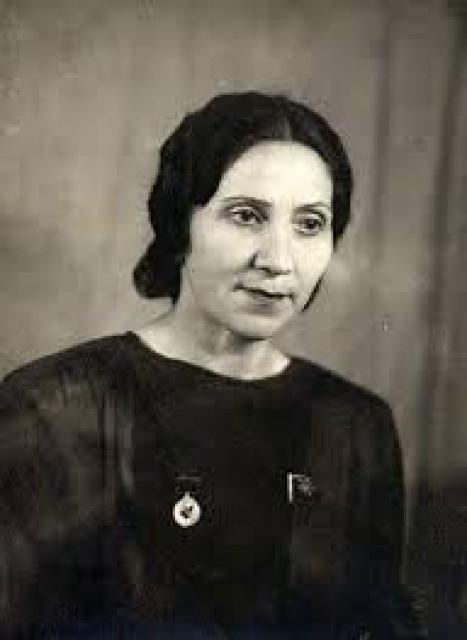
Marziya Davudova
- Early Life and Career
- Acting and Political Involvement
- Stalin Prize and National Recognition
- Family Life
- Legacy and Honors
Early Life and Career
Marziya Davudova was born Maria Shamakhynskaya on November 25 (December 8), 1901, in Astrakhan, Russia, to an Azerbaijani family. From 1917, she graced the stage of the Astrakhan Tatar Drama Theater. In 1920, she joined the Azerbaijan Drama Theater in Baku, where she would leave an enduring legacy.
Acting and Political Involvement
As an exceptional actress, Davudova's performances captivated audiences. Her significant contributions to the Azerbaijani cultural landscape earned her the coveted title of People's Artist of Azerbaijan SSR in 1936. Her commitment extended beyond the stage as she became a member of the Communist Party in 1942. Furthermore, she served as a deputy in the Supreme Soviet of Azerbaijan SSR from its second to fifth convocations.
Stalin Prize and National Recognition
Davudova's exceptional artistic abilities were recognized at the highest level when she was awarded the Stalin Prize of the second degree in 1948 for her mesmerizing portrayal of Gulzar in Elchin Mammadkhanli's play "Morning of the East." In 1949, she attained the prestigious title of People's Artist of the USSR, a testament to her immense talent and influence.
Family Life
Marziya Davudova's personal life was marked by two marriages. Her first union was with the renowned actor Abbas-Mirza Sharifzadeh (1893-1938) in 1923, with whom she had a daughter, Firangiz (1924-2014), who also became a respected actress. After parting ways with Sharifzadeh in 1928, Davudova married Ulvi Rajab in 1930. Their union brought forth a son, Rauf (born 1931).
Legacy and Honors
Marziya Davudova's life was cut short on January 6, 1962 (according to some sources, January 5 or 9) in Baku. She was laid to rest in the Alley of Honor, a testament to her revered status. Her contributions to Azerbaijani culture, both on and off stage, have left an indelible mark on the nation's artistic heritage. In addition to her numerous awards and accolades, her name adorns the Marziya Davudova Azerbaijan National Drama Theater, a fitting tribute to her unwavering dedication to the arts.


