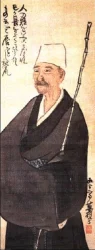
Matsuo Bashō
 Japan
Matsuo Bashō turned the smallest moments—a frog splashing into an old pond, a night’s chill, a traveler pausing beneath the moon—into poetry with the reach of a world. Remembered as Japan’s greatest haiku master, he was also a restless traveler, a gifted teacher, and a literary innovator who joined spare verse to reflective prose. His work helped transform haikai, once a playful collaborative pastime, into an art capable of quiet depth and lasting emotional force.
Early Life and a Poet’s Name
Born in 1644 in Iga, in present-day Mie Prefecture, Bashō came from a family of samurai background. His birth name is often given as Matsuo Munefusa. As a young man he served Tōdō Yoshitada, a local lord’s son who shared his interest in poetry. After Yoshitada’s death, Bashō left service and eventually settled in Edo, today’s Tokyo, where he built a reputation in the city’s flourishing literary circles.
He began within haikai no renga, a linked-verse form composed in collaboration. Its opening verse, the hokku, offered an opportunity for wit, surprise, and a sharply observed image. Bashō brought uncommon sensitivity to the form, drawing on classical Japanese and Chinese literature while making room for the textures of ordinary experience. In the early 1680s he lived in a modest riverside hut where a banana plant grew. His disciples gave him the poetic name “Bashō,” meaning “banana plant,” and the humble shelter became known as Bashō-an.
The Way of Travel
Restlessness and artistic curiosity drew him onto the roads. Bashō’s journeys were not simply sightseeing trips: landscape, weather, historical memory, and encounters with other people became material for poems and prose. He traveled with little comfort, stopping at temples and celebrated sites as well as in villages along the way. His travel writing blends what he saw with allusion, reflection, and carefully shaped scenes, making the reader feel the movement of the journey.
In 1689 he set out with his disciple Kawai Sora on a long journey through the northern provinces. The route and its impressions became the basis of “Oku no hosomichi,” commonly translated as “The Narrow Road to the Deep North” or “The Narrow Road to the Interior.” Part travel diary, part prose poem, and part sequence of haiku, it is widely regarded as his masterpiece. Bashō continued to revise the account after returning from the road; it was published after his death.
Lasting Influence
Bashō’s verse is celebrated for its concentration: a few words can open onto seasonal change, solitude, humor, or the transience of life. His famous old-pond poem, for example, makes a sudden sound carry the stillness around it. English translations differ, but the poem’s economy and resonant image have made it among the most recognized works of Japanese literature.
He spent his later years traveling and teaching, gathering students who helped carry his poetic ideals forward. Bashō died in Osaka in 1694, after falling ill while on the road. His influence endured in Japan and spread across the world, where generations of poets have looked to his attention, restraint, and sense of wonder. He remains not only a master of haiku, but a writer who made the journey itself a way of seeing.