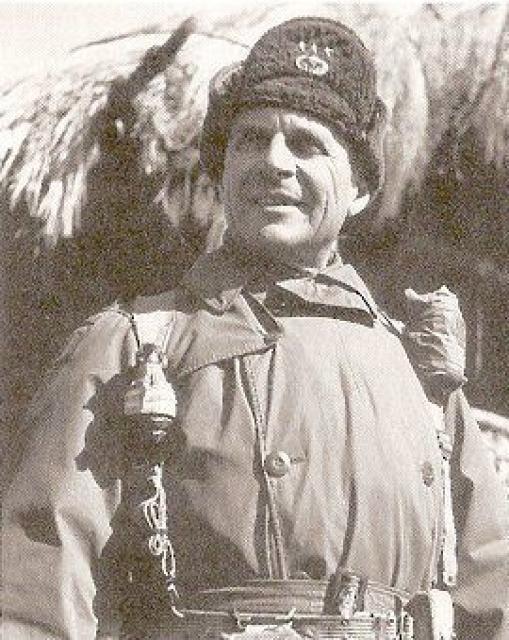
Matthew Bunker Ridgway
 USA
USA- Biography of Matthew Bunker Ridgway
- Early Military Assignments
- Service in China and Central America
- World War II and Korea
- Later Life and Legacy
Biography of Matthew Bunker Ridgway
Early Life and Military CareerMatthew Bunker Ridgway was born on March 3, 1895, in Fort Monroe, Hampton, Virginia. His father, Colonel Thomas Ridgway, was an artillery officer, and his mother was Ruth Ridgway. Matthew spent his childhood in military garrisons. He applied to West Point in 1912 but failed the geometry exam. He spent a year preparing and was finally accepted into the academy on June 14, 1913. He graduated in 1917, six weeks ahead of schedule, due to America's entry into World War I.

Early Military Assignments
Ridgway wanted to join the artillery, like his father, but all artillery positions had already been filled when it was his turn for assignment. Instead, he was assigned to the infantry as a second lieutenant in the U.S. Army. In the same year, he married Julia Caroline Blount, and they had two daughters before divorcing in 1930. Ridgway served on the Mexican border with the 3rd Infantry Regiment for a year before returning to West Point as an instructor. He taught Spanish and tactics and eventually became an assistant to the faculty.
Service in China and Central America
In 1924, Ridgway attended the Infantry Officer Course at Fort Benning, Georgia. After completing the course in 1925, he was assigned to the 15th Infantry Regiment in Tianjin, China. After his service in China, he led a company in the 9th Infantry Regiment in San Antonio, Texas. He was tasked with training a modern pentathlon team for the 1928 Olympics, but his assignment changed when he was called to serve in Nicaragua and later Bolivia and Paraguay.
World War II and Korea
During World War II, Ridgway played a crucial role in planning the airborne operations for Operation Overlord, the D-Day invasion of Normandy. He led the 82nd Airborne Division during the Sicily campaign and later participated in the Battle of the Bulge. In 1951, he took command of the U.S. Eighth Army in Korea and successfully halted the Chinese and North Korean offensives. In 1952, Ridgway became the Supreme Allied Commander Europe for NATO.
Later Life and Legacy
After his military career, Ridgway wrote memoirs and served on the boards of various corporations. He passed away on July 26, 1993, at the age of 89. Ridgway was buried in Arlington National Cemetery. Throughout his career, he received numerous awards and honors, including the Silver Star, Legion of Merit, Purple Heart, and Presidential Medal of Freedom. Ridgway's leadership and strategic abilities left a lasting impact on the U.S. military.


