Mausolus
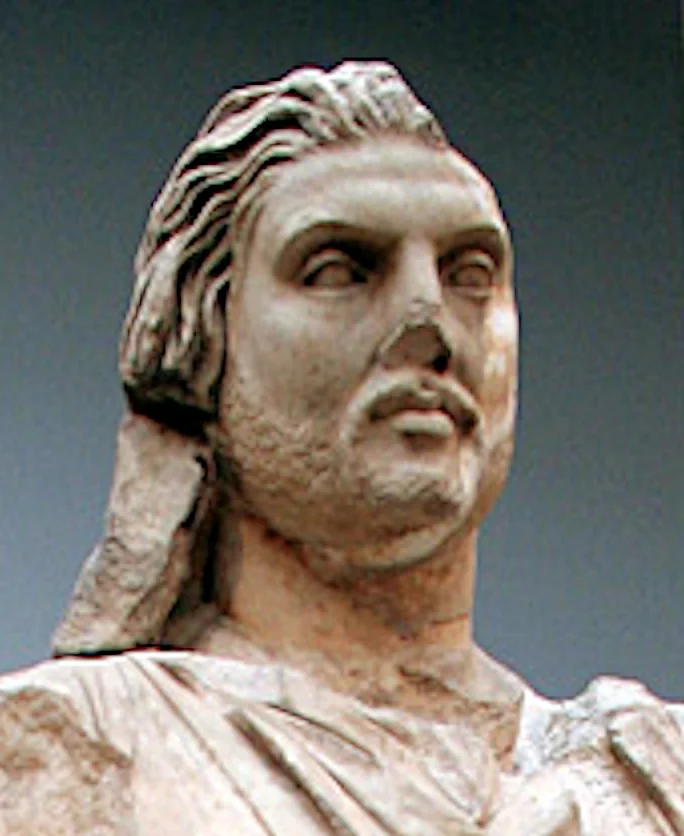
Mausolus was the satrap of Caria in southwestern Anatolia from about 377 to 353 BC. Though formally a governor serving the Persian Achaemenid king, he exercised broad authority and ruled his territory with the independence of a local monarch. He moved his capital to the coastal city of Halicarnassus, expanded Carian influence across the Aegean, and began the monumental tomb that would make his name endure.
A Carian Dynasty
Mausolus was the eldest son of Hecatomnus, a Carian noble who had been appointed satrap by Persia and established a hereditary ruling house. The Hecatomnids governed within the Achaemenid Empire, but their family cultivated its own authority, diplomacy, and cultural identity. Mausolus succeeded his father around 377 BC and maintained the formal title of satrap while acting as a powerful regional ruler.
He married Artemisia, his sister, who later succeeded him as Artemisia II. The couple presented themselves as a royal pair, reflecting their status in Caria even while they remained within the Persian imperial system. Mausolus had no known children, and after his death authority passed to Artemisia.
Building a Capital
Mausolus transferred his seat of government from inland Mylasa to Halicarnassus, a Greek-speaking port on the Aegean coast. The move strengthened his access to maritime trade and made the city a showcase for Hecatomnid power. He expanded its defenses and developed its harbor, palace, temples, and civic spaces. Halicarnassus became a major center in the region, shaped by both Carian traditions and Greek cultural forms.
His power also extended beyond Caria. Mausolus used a fleet and strategic alliances to influence Greek cities and islands across the Aegean, including Rhodes, Cos, and Chios. In the 360s BC he joined forces with the satrap Autophradates in operations against Ariobarzanes, a Persian governor who had rebelled. These shifting alliances show how Mausolus balanced his obligations to the Persian king with his own regional interests.
The Mausoleum
Mausolus’s most famous legacy was the tomb built at Halicarnassus. Construction began during his lifetime, but he died in 353 BC before it was complete. Artemisia continued the project, bringing renowned architects and sculptors to finish the monument. The structure combined a high podium, a colonnaded temple-like level, a stepped roof, and a sculpture of the ruler and queen in a chariot. Its scale and artistic richness made it one of the Seven Wonders of the Ancient World.
The tomb became known as the Mausoleum of Halicarnassus, and its name eventually gave English the general word “mausoleum” for a grand tomb. It commemorated not only Mausolus but also the power of the dynasty that had transformed Caria into an influential regional state.
Mausolus’s career illustrates the flexible nature of Persian rule in western Anatolia. He remained a satrap within a vast empire, yet he built a powerful local court, cultivated Greek alliances, and reshaped his capital as a lasting monument to Hecatomnid authority.