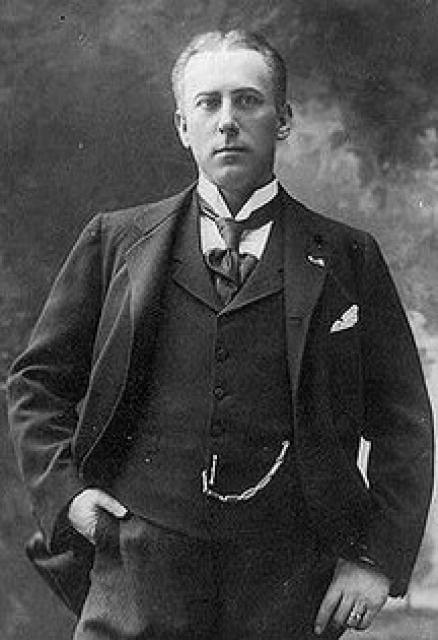
Max Alvary
 Germany
- Early Life and Education
- Debut and Rise to Prominence
- International Acclaim and Wagnerian Success
- Bayreuth Festival and Metropolitan Opera
- Renowned Roles and Later Years
Early Life and Education
Max Alvary(born Andreas Achenbach) was born in Düsseldorf, Germany, into a family of artists. His father, Andreas Achenbach, was a renowned landscape painter. Max received his musical education in Frankfurt am Main under the esteemed pedagogue Julius Stockhausen and later in Milan with the equally renowned Francesco Lamperti.
Debut and Rise to Prominence
1879marked Alvary's professional debut under the pseudonym Max Alvary in Weimar's Court Theater as Alessandro Stradella in Friedrich von Flotow's opera of the same name. He quickly gained recognition for his dramatic tenor voice and charismatic stage presence, and soon became a regular performer at the theater until 1885, where he frequently sang leading tenor roles in works such as Flotow's "Martha," Donizetti's "Don Giovanni," and "Lucrezia Borgia."
International Acclaim and Wagnerian Success
From 1885 onward, Alvary embarked on successful tours of America and England. 1885saw his debut at the Metropolitan Opera in New York City, where he sang alongside the legendary soprano Lilli Lehmann in Bizet's "Carmen." He performed at the Met until 1889, and also toured extensively in cities like Boston, Philadelphia, and Washington.
Alvary's career took a significant turn when he began performing in Wagner's operas. His commanding presence and vocal power made him a sought-after interpreter of Wagnerian heroes.
Bayreuth Festival and Metropolitan Opera
1891marked Alvary's debut at the Bayreuth Festival, where he appeared in "Tannhäuser" opposite Pauline de Ahna, the future wife of Richard Strauss, and in "Tristan und Isolde." The same year, he also sang at the Munich Court Opera and, in 1891, at Hamburg's Municipal Opera Theater.
1892-93saw Alvary's triumphant portrayal of Siegfried in the first complete English production of Wagner's "Ring Cycle" at London's Covent Garden. His interpretation of Siegfried without a beard drew particular attention from audiences.
Renowned Roles and Later Years
In addition to Siegfried, Alvary's notable roles included Pylades in Gluck's "Iphigénie en Tauride," Florestan in Beethoven's "Fidelio," Max in Weber's "Der Freischütz," and Loge in Goldmark's "Merlin." He was also a renowned interpreter of oratorios.
A tragic event occurred in 1893 during a rehearsal of "Siegfried" in Mannheim's Court Theater. Alvary fell into an open trapdoor and sustained severe injuries. He never fully recovered from the accident and was forced to retire from the stage in 1896.
Max Alvary passed away in Tabarz, Thuringia, in 1898, leaving behind a legacy of unforgettable performances that continue to be celebrated in the annals of opera history.