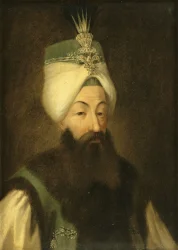
Mehmed II
- A young ruler returns to power
- The conquest of Constantinople
- Builder, patron, and strategist
- The legacy of “the Conqueror”
Mehmed II remade the Ottoman state into an empire with ambitions across Europe and Asia. Known as “Fatih,” or “the Conqueror,” he is most closely associated with the capture of Constantinople in 1453, a victory that ended the Byzantine Empire and made the ancient city his capital. Yet his reign was also marked by state-building, a broad program of territorial expansion, and a court that drew on Muslim, Byzantine, and Italian traditions.
A young ruler returns to power
Mehmed was born in Edirne on March 30, 1432, the son of Sultan Murad II. He first ascended the Ottoman throne in 1444, when his father withdrew from rule and the boy became sultan at about twelve years old. The young ruler faced a difficult political climate, and Murad soon returned to the throne. Mehmed’s first reign ended in 1446, but he had already learned how unstable power could be.
When Murad died in 1451, Mehmed succeeded him again. At nineteen, he was now determined to secure the Ottoman position around Constantinople, the Byzantine capital surrounded by Ottoman territory. He strengthened the state’s hold on the Bosporus and prepared for a direct assault on the city, whose walls had resisted numerous sieges over centuries.
The conquest of Constantinople
In the spring of 1453, Mehmed’s forces laid siege to Constantinople. The city was defended by Emperor Constantine XI and a much smaller force. Ottoman artillery battered the land walls while the besiegers blockaded the sea approaches. After weeks of fighting, Ottoman troops entered the city on May 29. Constantine XI died during the final defense, and Byzantine rule came to an end.
The conquest was a watershed for both the Ottoman state and the wider region. Mehmed transferred his imperial center to Constantinople, later known as Istanbul, and set about restoring its population and institutions after the destruction and displacement of the siege. He appointed the scholar Gennadios Scholarios as Orthodox patriarch, allowing the church to continue under Ottoman sovereignty. The new capital became a meeting place of peoples, faiths, and political traditions, even as the Ottoman ruler asserted firm control.
Mehmed’s ambitions extended well beyond the city. His campaigns brought much of the Balkans, the Black Sea coast, and additional Anatolian territories under Ottoman rule. In 1461 he conquered the Empire of Trebizond, one of the last Byzantine successor states. These expansions helped transform an already powerful sultanate into a far-reaching imperial power.
Builder, patron, and strategist
Mehmed also reshaped the machinery of government. He worked to strengthen the central authority of the sultan, reorganized administration, and issued legal regulations that helped standardize imperial rule. Rebuilding Constantinople involved attracting new residents and developing institutions, markets, religious foundations, and monumental architecture. His rule could be forceful and exacting, but the empire he assembled was designed to govern a diverse population across a vast territory.
He took a keen interest in scholarship and the arts. His court welcomed Muslim scholars, Greek intellectuals, and artists from Italy. In 1479, the Venetian painter Gentile Bellini came to Constantinople; the portrait he made of Mehmed is among the most famous images of an Ottoman ruler. Mehmed’s interest in Roman and Byzantine history reflected an imperial self-image that reached beyond the boundaries of a single tradition.
The legacy of “the Conqueror”
Mehmed II died in 1481 while preparing for another campaign. He was forty-nine. His reputation has long been dominated by the capture of Constantinople, but his broader impact lay in consolidating the state that would become the Ottoman Empire at its height. His reign left a transformed capital, a more centralized government, and an empire whose political and cultural reach continued to grow under his successors.