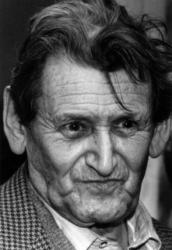
Michael Agurskiy
- Early Life and Education
- Technical Career and Academic Pursuits
- Personal Relationships and Intellectual Awakening
- Spiritual Guidance and Connections
- Professional Transition and Activism
- Zionist and Dissident Engagements
Early Life and Education
Mikhail Samuilovich Agursky, also known as Melik, Melyr, or Melyb, was born in Moscow in 1933 to a renowned revolutionary and historian, Samuil Khaimovich Agursky. Mikhail's exceptional education began with his graduation from school in Moscow in 1950.
Technical Career and Academic Pursuits
Despite his literary pseudonym, Mikhail pursued higher technical education. He began his career in the 1960s at ENIMS, an experimental research institute specializing in metal-cutting machine tools. In 1965, he left his position to pursue a doctorate at the Institute of Automation and Telemechanics of the USSR Academy of Sciences. He continued his academic journey at the Research Institute of Machine-Building Technology, submitting his successful doctoral dissertation in cybernetics in 1969.
Personal Relationships and Intellectual Awakening
In 1955, Mikhail married Vera Fedorovna Kondratieva. His pursuit of knowledge extended beyond technical studies. Through his connections with poets and thinkers like Alexander Laiko, he joined the underground literary scene and co-founded the "Fakel" youth poetry club. His intellectual curiosity led him to explore the works of Russian religious philosophers and the history of Zionism.
Spiritual Guidance and Connections
A pivotal figure in Mikhail's life was the preacher Alexander Men. Men's mentorship and openness to different faiths fostered Mikhail's connections within the Orthodox Church, the dissident movement, and the Zionist community. His profound knowledge of religious philosophy and advocacy for Israel strained his status as an employee of a military-related institution.
Professional Transition and Activism
In 1970, Mikhail left his job at the Research Institute of Machine-Building Technology to focus on biocybernetics. However, he faced obstacles in securing employment at the Institute of Automation and Telemechanics. With limited work opportunities, he supported his family through translations and collaborations with the Moscow Patriarchate Journal.
Zionist and Dissident Engagements
Mikhail's growing financial and social independence allowed him to align himself with Zionist refuseniks like Vladimir Slepak and Alexander Lerner, as well as prominent dissidents such as Yuri Glazov, Valentin Turchin, and Naum Korzhavin. In the early 1970s, he grappled with the decision of whether to continue his scientific career in the Soviet Union or pursue a life of Zionism abroad.