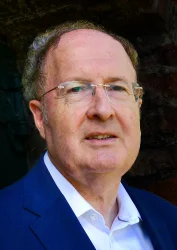
Michael Houghton
Michael Houghton helped solve a medical mystery that had frustrated researchers for decades: the cause of many cases of hepatitis transmitted through blood that were not explained by hepatitis A or B. His team identified the genetic material of the virus later named hepatitis C, opening the way to blood-screening tests that transformed transfusion safety. The discovery earned him a share of the 2020 Nobel Prize in Physiology or Medicine.
From Britain to Molecular Biology
Houghton was born in the United Kingdom in 1949. He studied biological sciences at the University of East Anglia, graduating in 1972, then completed a PhD in biochemistry at King’s College London in 1977. With research positions at Searle Laboratories and later Chiron Corporation in California, he built a career in molecular biology at the intersection of academic science and biotechnology.
At Chiron, Houghton initially worked on interferons and other antiviral research. He became interested in “non-A, non-B” hepatitis, a serious liver disease that doctors knew could be transmitted by blood but could not attribute to either of the two known hepatitis viruses. The disease could remain hidden for years before causing chronic liver damage, cirrhosis, or liver cancer. Identifying its cause was an urgent scientific and public-health challenge.
Identifying Hepatitis C
The search demanded a new strategy. Houghton’s team used molecular techniques to examine genetic material from an infected chimpanzee and search for viral sequences in a vast collection of cloned DNA. After years of false starts, the researchers found a clone derived from the virus’s RNA genome. In 1989, Houghton, Qui-Lim Choo, George Kuo, and collaborators including Daniel Bradley published the identification of what became known as hepatitis C virus.
The work made it possible to create reliable tests for donated blood. Houghton’s group and others developed diagnostics that allowed blood banks to screen donations, dramatically reducing hepatitis C transmission through transfusion. The discovery also gave researchers a way to study the virus itself and identify targets for treatments.
Houghton later emphasized the team nature of the achievement. In 2020, the Nobel Prize was shared among Houghton, Harvey J. Alter, and Charles M. Rice. Alter had established that a previously unknown infectious agent caused many cases of post-transfusion hepatitis, Houghton’s team identified the virus, and Rice provided evidence that it could replicate and cause disease. Together, their work completed a chain of discovery that changed care for patients around the world.
Research and Public Health
Houghton became a central figure in hepatitis research at Chiron, serving as director and later vice-president of hepatitis C research. After roles in biotechnology, he moved to the University of Alberta in 2010 as a Canada Excellence Research Chair in Virology and the Li Ka Shing Professor of Virology. He became director of the university’s Li Ka Shing Applied Virology Institute.
At Alberta, his work broadened to vaccine research and other viral and biomedical problems. In 2013, his team reported that a vaccine candidate derived from one hepatitis C strain could protect cell cultures against many global strains. That result was an important step in a field where vaccine development is difficult because the virus has many variants; it was not itself an approved human vaccine.
Legacy
Houghton’s achievement joined molecular discovery to practical prevention. Before hepatitis C could be identified, blood transfusions carried an unrecognized risk; after the discovery, screening could prevent countless infections. The Nobel Prize recognized this scientific turning point alongside Alter’s and Rice’s contributions. His career illustrates how a determined team working across a laboratory and a public-health system can turn an invisible pathogen into a target for diagnosis, treatment, and prevention.