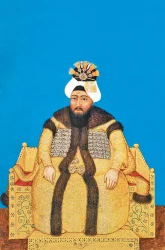
Michael VI Bringas
Michael VI Bringas was Byzantine emperor for barely a year, from 1056 to 1057. A senior civilian official chosen by the aging Empress Theodora as her successor, he inherited an empire in which military commanders and court officials competed for influence. His reign ended when a revolt led by Isaac Komnenos forced him to abdicate, exposing the tensions between the capital’s bureaucracy and the army’s aristocratic leadership.
A court official becomes emperor
Little is known about Michael’s early life. Before his accession he held the office of logothete of the military treasury, an administrative post that managed resources for the armed forces. His surname, Bringas, was associated with a family of civil officials. Later sources also call him Stratiotikos, a title linked to his former post, and Gerontas, meaning “the old man.”
In 1056, the elderly Empress Theodora, last ruler of the Macedonian dynasty, selected Michael as her successor shortly before her death. His elevation kept power in the hands of the civilian court faction that had served her. Michael’s government rewarded officials and military officers, but the distribution of honors and resources deepened resentment among important commanders, particularly those serving in the eastern provinces.
Revolt and abdication
Discontent among senior generals grew during 1057. After one prominent commander, Nikephoros Bryennios, was arrested and blinded following a conspiracy, other military leaders rallied around Isaac Komnenos. On 8 June, they proclaimed Isaac emperor in Paphlagonia. The rebellion advanced toward Constantinople, and the two sides fought a major battle at Petroe near Nicaea in August.
Michael’s forces were defeated. The patriarch of Constantinople, Michael Keroularios, and other influential figures urged the emperor to avoid further bloodshed. Michael agreed to abdicate on 31 August 1057, and Isaac entered Constantinople the next day. The peaceful transfer avoided a prolonged siege of the capital, though the military revolt had already exposed how fragile Michael’s support had become.
Final years and legacy
After giving up the throne, Michael retired to a monastery. His exact date of death is uncertain. His brief rule is often treated as a turning point between the Macedonian dynasty and the rise of powerful military families, especially the Komnenoi. The episode showed that an emperor chosen by the court could not govern securely without the support of the provincial army and its commanders.