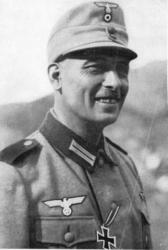
Michael Wittmann
 Germany
Biography of Michael Wittmann
Michael Wittmann (1914-1944) was the greatest tank ace of World War II. He was born on April 22, 1914, in Vogeltal, in the Upper Palatinate district. After completing his secondary education, he worked on his father's farm and briefly joined the Volunteer Labor Service (FAD) in 1934. In the same year, he was conscripted into the army and served for two years in the 19th Infantry Regiment in the Munich military district, eventually attaining the rank of non-commissioned officer.
In 1937, Wittmann joined the SS as a volunteer and was assigned to the Leibstandarte "Adolf Hitler," which provided personal security for the Fuhrer. The unit later became the 1st SS Panzer Division, stationed in Berlin-Lichterfelde. Wittmann's calm, composed, modest, and conscientious nature, combined with the camaraderie among the SS troops and the allure of the black uniform, attracted many young German men to join the SS. By the outbreak of the Second World War, Wittmann was already an Untercharfuehrer SS in the division's artillery battalion.
Wittmann gained combat experience in Poland, France, Belgium, and Greece, where he operated a self-propelled gun. However, it was not until the division crossed into the Soviet Union in June 1941 that Wittmann's skills as a tank commander began to shine. Unlike tanks, German self-propelled guns were primarily used as transport vehicles, anti-tank weapons, and mobile reserves for divisional commanders.
Unterscharfuehrer Wittmann quickly earned a reputation as a brave, cool-headed, and decisive warrior. With his steady nerves, he would allow enemy tanks to come within close range before destroying them with a single shot. During the summer and fall of 1941, he destroyed several Soviet tanks, including a memorable incident where he single-handedly stopped an attack by eight Soviet tanks, causing six to catch fire and two to flee. By 1941, Wittmann had been awarded the Iron Cross of both classes and the Tank Assault Badge.
In mid-1942, after the Leibstandarte "Adolf Hitler" was transferred back to France for rest and reorganization, Wittmann was sent to Germany for further training at the military academy in Bad Toelz. After successfully completing his training, he was promoted to the rank of Untersturmfuehrer SS on the eve of the new year in 1942. He then returned to the Eastern Front.
In Russia, Wittmann was given command of a platoon of Tigers in the 13th Tank Company (Heavy Tanks) of the 1st SS Panzer Corps. While these monstrous tanks were slow and lacked maneuverability, they were heavily armored and equipped with powerful 88mm guns. Wittmann became a virtuoso of this deadly weapon. On July 5, 1943, during the first day of the Battle of Kursk, he personally destroyed eight Soviet tanks and seven artillery guns. Wittmann's calm and methodical approach, combined with the coordinated actions of his well-trained crew, soon created his legendary reputation as the greatest tank ace in military history. During the Battle of Kursk, he destroyed 30 Soviet tanks and 28 guns.
After the failure of Operation Citadel, the German armies were forced to retreat. Wittmann was one of the few who remained on or near the front lines, covering the troops' withdrawal or launching counterattacks when necessary. In one battle during the winter campaign of 1943-1944, he destroyed ten Soviet tanks in a single day. On January 14, 1944, he was awarded the Knight's Cross, and just sixteen days later, he was presented with Oak Leaves. A few days later, Wittmann was promoted to the rank of Obersturmfuehrer SS. By April 1944, when Wittmann left the Eastern Front, his tally stood at 119 destroyed Soviet tanks. However, his greatest challenges awaited him on the Western Front.
On June 6, 1944, when the Allied forces landed in Normandy on D-Day, Wittmann's 501st Battalion was stationed in Beauve, France. The next day, the battalion began its march to reunite with the I SS Panzer Corps in Normandy. The task was not easy, as Allied aircraft had destroyed most of the bridges south of Paris, making daytime movement extremely dangerous. After the 2nd Company was ambushed and decimated by ground-attack aircraft in an open area near Versailles, the 501st Battalion could only move at night. Wittmann's platoon, known as "the tip of the spear," arrived in the combat zone on the night of June 12-13 and took up concealed positions northeast of Villers-Bocage on the left flank of the corps' rear.
Wittmann intended to spend the next day repairing tanks damaged by bomber raids. However, the British forces had other plans. On the morning of June 13, a strong battle group from the British 7th Armoured Division found a gap in the stretched German defensive line and began advancing along the entire left flank of the SS training division. They infiltrated the German rear, bypassing Villers-Bocage. Unaware of the resistance they would encounter, the British hastily lowered their guard. Wittmann opened fire on the first British Sherman tank at a distance of 80 meters, instantly turning it into a burning heap of metal. In just a few seconds, he destroyed three more Shermans and then rammed into the column at full speed. The British soldiers were terrified as Wittmann's Tiger crushed the first armored vehicle. Many of them jumped out of their tanks and fled. Wittmann approached them at a distance of 30 meters, stopped, fired, watched as his target exploded into millions of fragments, and then moved on to his next victim.
A British Cromwell tank fired at Wittmann's Tiger with its 75mm gun, but the shot bounced off the thick armor of the German tank giant. Wittmann aimed his 88mm gun at the Cromwell and set it ablaze. Meanwhile, his crew sprayed machine gun fire at the British infantry and the disoriented vehicles that had lost formation. The light tanks of the British 8th Battalion were attacked by four other Tigers from Wittmann's platoon, and soon, many allied tanks were set on fire. Wittmann tore through the enemy forces, slowing down their advance toward Villers-Bocage, while destroying several tanks and armored vehicles along the way.
Wittmann's counterattack halted the British breakthrough, and by nightfall, Villers-Bocage was back in German hands. The British launched a counterattack on the demolished village, deploying six hundred tanks. After several hours of battle, they managed to regain their previous position. However, they were unable to capitalize on their success as the Germans brought in reinforcements.
When "tank ace" Kurt Meyer fell back under pressure from the 85th Infantry Division, the German front was no longer in danger of collapse. However, Wittmann was no longer with him. He was last seen commanding the rearguard, engaging in a fierce battle with five Shermans in his solitary Tiger.
It was reported that he went missing in action that evening, and that remained the case for the next 43 years.