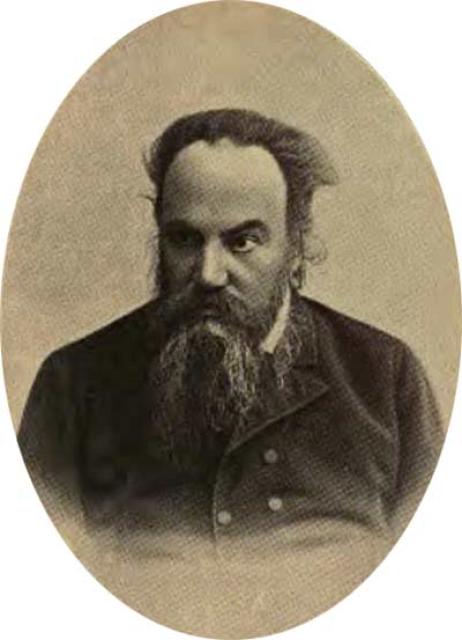
Mihail Protopopov
 Russia
- Early Life and Education
- Literary Debut and Critical Writings
- Imprisonment and Exile
- Literary-Critical Characteristics
- Humorous Writing and Legacy
Early Life and Education
Nikolai Arkadyevich Protopopov was born in 1848 in the town of Chukhloma to a civil servant father. His family had a distinguished lineage, with his grand-uncle being Athanasius Protopopov, the Archbishop of Tobolsk. Protopopov attended the Konstantin Institute of Surveying in Moscow and served briefly as a topographic officer.
Literary Debut and Critical Writings
Protopopov debuted as a literary critic in 1877 with the article "Literary Malice of the Day" in the journal "Otechestvennye Zapiski." Using the pseudonym N. Morozov, he became a regular contributor to the magazine's "New Books" section until its closure. Throughout the 1880s, Protopopov wrote for various newspapers and journals, including "Russkaya Pravda," "Slovo," "Ustoi," and "Delo."
Imprisonment and Exile
In 1884, Protopopov was arrested and imprisoned for six months. He was then exiled to Chukhloma for several years. During the late 1880s, he contributed to "Severny Vestnik," and in the 1890s, he became an active writer for "Russkaya Mysl" and "Russkoe Bogatstvo."
Literary-Critical Characteristics
Protopopov's critical writings explored the social and moral implications of literary works, following in the tradition of Russian publicist critics. He was particularly influenced by the ideas of Dobrolyubov, Pisarev, and Chernyshevsky. His analysis focused on the work's impact on society rather than its purely literary aspects.
Humorous Writing and Legacy
Despite his serious critical approach, Protopopov possessed a remarkable talent for humorous writing. His satirical articles, characterized by witty and refined humor, are considered some of the best examples of literary wit. His critical writings and bibliographic notes continue to be valued for their incisive analysis and engaging prose.


