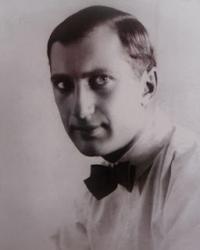
Mihailo Stelmah
 Ukraine
- Biography of Mykhailo Stelmakh
- Education and Early Career
- Contributions during World War II
- Literary Career
- Recognition and Awards
Biography of Mykhailo Stelmakh
Mykhailo Stelmakh was a Soviet Ukrainian writer and playwright, a laureate of the Stalin Prize (1951), and a Hero of Socialist Labor (1972). He was born on May 11, 1912, in the village of Dyakovtsy (currently in the Litin district of the Vinnytsia region, Ukraine) into a poor peasant family.
Education and Early Career
After completing school in 1929, Stelmakh enrolled in the Vinnytsia Pedagogical Technical School, and later attended the literary faculty of the Vinnytsia Pedagogical Institute, graduating in 1933. From 1933 to 1939, he worked as a teacher.
Contributions during World War II
During World War II, from 1939 to 1945, Stelmakh served in the Red Army, initially as a private artilleryman. In 1944, after sustaining two severe injuries and receiving treatment in Ufa, he became a correspondent for the First Ukrainian Front under the pen name "Za Chest Otechestva" ("For the Honor of the Motherland"). His collections of poetry were published in Voronezh and Ufa during the war.
Literary Career
After the war, Stelmakh joined the Institute of Art Studies, Folklore, and Ethnography of the Academy of Sciences of the Ukrainian SSR, where he worked until 1953. He wrote a trilogy of novels, including "Bolshaya Rodnya" (1950), "Krov Lyudska - Ne Voditsya" (1957), and "Khleb i Sol" (1959). This trilogy was adapted into films by the Oleksandr Dovzhenko Film Studio, including "Krov Lyudska - Ne Voditsya" (1960), "Dmytro Horytsvit" (1961), and "Lyudi Ne Vse Znayut" (1963). Stelmakh also wrote novels such as "Pravda i Krivda" (1961) and "Duma Pro Tebya" (1969), as well as children's stories like "Gusi-Lebedi Letyat" (1964) and "Shchedryi Vechir" (1967).
Recognition and Awards
Several films were made based on Stelmakh's screenplays, including "Nad Cheremoshem" (1954, directed by H.T. Krykun), "Zhyvi, Ukraino!" (1958), "Khleb i Sol" (1970), "Gusi-Lebedi Letyat" (1974), and "Shchedryi Vechir" (1976). He received numerous awards throughout his career, including the Lenin Prize (1961) for his trilogy "Khleb i Sol" (1959), "Krov Lyudska - Ne Voditsya" (1957), "Bolshaya Rodnya" (1949-1950), the Stalin Prize of the third degree (1951) for the novel "Bolshaya Rodnya" (1949-1950), the State Prize of the Ukrainian SSR named after T.H. Shevchenko for the novel "Chetyre Broda" (1979), and three Orders of Lenin, among others.
Mykhailo Stelmakh passed away on September 27, 1983, and was buried in Kyiv at the Baikove Cemetery. His son, the renowned writer and screenwriter Ya. M. Stelmakh (1949-2001), followed in his footsteps in the literary field.