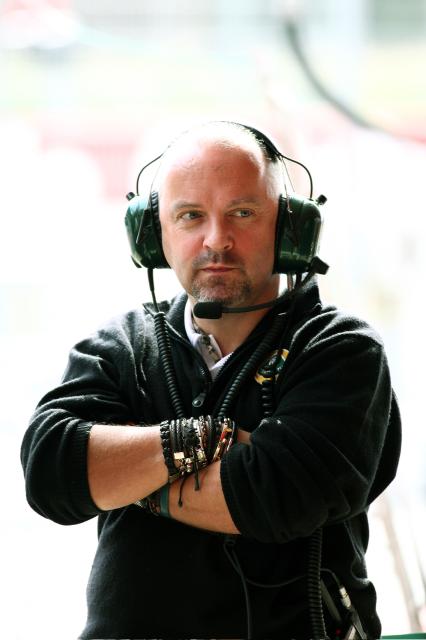
Mike Gascoyne
 Great Britain
- From Cambridge to the F1 Paddock
- Jordan and a Breakthrough Design
- Building Lotus and Caterham
- Engineering Beyond Racing
- An Engineer Who Keeps Moving
Mike Gascoyne became one of Formula One’s most recognizable engineering leaders by combining aerodynamic insight with a builder’s appetite for new challenges. He helped shape cars for McLaren, Jordan, Renault, Toyota, and other teams, then turned his attention to launching a new F1 operation, offshore sailing, and advanced engineering beyond motorsport.
From Cambridge to the F1 Paddock
Born on April 2, 1963, in Norfolk, England, Michael “Mike” Gascoyne studied engineering at the University of Cambridge, specializing in aerodynamics and fluid dynamics. While pursuing postgraduate research, he spotted an advertisement for an aerodynamicist at McLaren in an issue of Flight magazine. The unexpected opening took him from academic research into the high-pressure world of Formula One.
Gascoyne joined McLaren in 1989 and moved to Tyrrell the following year, where he worked with designer Harvey Postlethwaite. When Postlethwaite joined Sauber in 1991, he brought Gascoyne along. After a spell in Switzerland, Gascoyne returned to Tyrrell, rising through its technical ranks and helping lead the design effort during a challenging period for the independent team.
Jordan and a Breakthrough Design
In 1998, Gascoyne became technical director at Jordan Grand Prix. The team’s 1999 Jordan 199 became its most successful car: Heinz-Harald Frentzen won two races, the team claimed a pole position, and Jordan finished third in the constructors’ championship. The season established Gascoyne as a technical leader capable of turning limited resources into a competitive package.
He joined Renault in 2001 as technical director, contributing to the team’s rise back to the front of the grid. Renault’s 2003 Hungarian Grand Prix victory marked a milestone in its modern F1 campaign. In late 2003, Gascoyne moved to Toyota as technical director for chassis, taking on a major role in a manufacturer-backed project with world championship ambitions. He later held senior technical positions with Spyker and Force India.
Building Lotus and Caterham
In 2009, Malaysian businessman Tony Fernandes brought Gascoyne in to help establish a new Formula One team, initially called Lotus Racing. Through his MGI Motorsport consultancy, he led the technical effort to design and produce the team’s first car in just five months for the 2010 season. The operation later competed as Caterham, expanding into a broader group with projects in GP2, Le Mans, composites, and road-car engineering.
The new team faced the steep challenge of building an organization and a competitive car from scratch. Although it never reached the front of the grid, the project showcased Gascoyne’s strengths in assembling technical programs, setting deadlines, and coordinating engineering across a fast-moving operation. He served as a senior technical leader at Caterham until the middle of the 2010s.
Engineering Beyond Racing
Gascoyne founded MGI in 2003 and returned to lead it full time after his Caterham years. The consultancy applies methods developed in high-performance motorsport to automotive, marine, and aerospace projects. From 2019 to 2021, he also served as chief technology officer at Vertical Aerospace and chief executive of its advanced engineering division, working in the emerging electric vertical takeoff and landing sector. He is again chief executive of MGI Engineering.
Sailing provided another arena for his appetite for technical competition. Gascoyne helped launch the Caterham Challenge Class 40 sailing campaign, crossed the Atlantic solo in 2012, competed in the 2013 Transat Jacques Vabre with Brian Thompson, and skippered a yacht to podium finishes in major 2015 offshore races, including the Fastnet.
An Engineer Who Keeps Moving
Gascoyne’s career has never followed a straight line from one racing team to the next. The same curiosity that took him from Cambridge research to an F1 wind tunnel later carried him into team building, sailing, and aerospace. Across each field, his focus has remained consistent: bring rigorous engineering to difficult projects, organize people around a deadline, and find performance where others see constraints.