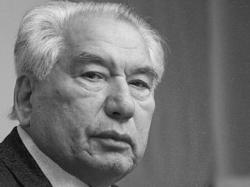
Moisey Altman
 Ukraine
- Biography of Moishe Altman
- Early Life and Literary Career
- Emigration and Return
- Arrest and Imprisonment
- Later Years and Legacy
Biography of Moishe Altman
Moishe Altman, a Jewish writer, was born in the town of Lipkany, located on the left bank of the Prut River in 1890. Lipkany has given the modern Jewish literature a whole constellation of names, which is why the Jewish poet Haim-Nahman Bialik called them the "Bessarabian Olympus". Altman studied at the heder and until 1908 in a private gymnasium in Kamenets-Podolsk together with another famous future poet and playwright, Yankov Sternberg.
Early Life and Literary Career
Altman debuted with poems and literary criticism in 1920 in Bucharest, where he lived from 1918. Later, he mostly focused on prose, publishing in various publications in Romania, Poland, and the United States. His first collection of novellas, "Blandenish" (Mirage), was published in Chernivtsi in 1926, followed by a collection of stories, "Di Viner Karete" (Viennese Carriage, 1935), and novels such as "Medresh-Pinkhes" (The Legend of Pinchos, 1936) and "Shmeterlingen" (Butterflies, 1939). Altman gained wide recognition as a brilliant stylist.
Emigration and Return
In 1930, Altman immigrated to Argentina, where he served as the director of a Jewish orphanage in Buenos Aires. However, he returned to Bucharest after just one year and worked as an editor for the literary weekly "Di Vokh" (The Week). In 1939, together with the renowned director Yankov Sternberg, Altman crossed the Dniester River, which was then the border with the Soviet Union. Shortly after, Bessarabia and Bukovina became part of the Soviet Union, and Altman returned to Soviet Moldavia. He became a member of the Union of Soviet Writers and went into evacuation in Central Asia during the war.
Arrest and Imprisonment
After the war, Altman settled in Chernivtsi, where he worked as a literary editor for the relocated Kiev Jewish Theater. He published stories and the play "Dos Tsente Gebot" (The Tenth Commandment, 1948) in Moscow's Jewish periodicals. In early 1949, a book of his war stories was published in Moscow, but on April 15th, he was arrested in connection with the so-called Case No. 5390 involving a Trotskyist-nationalist group of Bessarabian writers. Altman was transferred from Chernivtsi to Kishinev, where the other accused local writers - Yankl Yakir, Motl Saktsier, and Hertsl Gaysiner-Rivkin - were already detained. In late September of the same year, each of the accused was sentenced to ten years of strict regime labor camps and sent to Kuibyshev. Altman and Saktsier were later sent to BAM.
Later Years and Legacy
After his release and rehabilitation in 1955, Altman returned to his daughter in Chernivtsi, where he lived until the end of his life. In the same year, a book of his selected prose was published in New York under the editorship of Shlomo Bickel. In 1959, a collection of his war stories was published in Moscow in Russian translation, and in the same year, the entire issue of the journal "Idishe Shriftn" (Jewish News) in Warsaw was dedicated to his works. In 1961, the publication of works by Soviet Jewish writers in Yiddish resumed in the Soviet Union, and Altman began collaborating with the journal "Sovetish Geimland" (Soviet Homeland). Over the next two decades, his plays, poems, essays, stories, sketches, and translations of Russian and world literature (A.N. Ostrovsky, Leonid Leonov, Moliere, etc.) appeared in this journal. In 1980, two volumes of his selected prose were published by the Moscow publishing house "Sovetsky Pisatel." Altman remained one of the most sophisticated stylists of contemporary Yiddish prose, and his name is firmly associated with the period of its highest flourishing.