Molla Panah Vagif
 Azerbaijan
Biography of Molla Panah Vagif
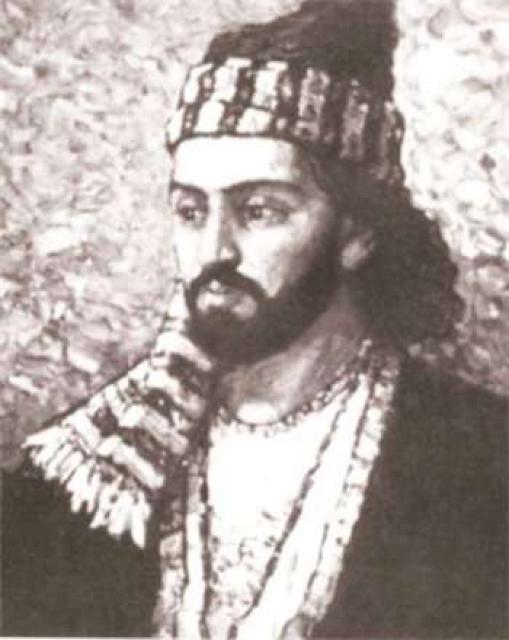
Molla Panah Vagif was an Azerbaijani poet and statesman. He was born around 1717 in the village of Salahly (now in the Kazakh district of Azerbaijan) into a peasant family. Vagif was well-versed in Arabic and Persian languages. He studied music and singing under the guidance of renowned aghas (singers) and was able to improvise songs himself. He started his career as a teacher, hence the title "molla" attached to his name, and later became the vizier (foreign minister) of the ruler of Karabakh.
During his time as vizier, Vagif displayed exceptional diplomatic skills. He played a crucial role in establishing a defensive alliance between Karabakh, Georgia, Talysh, and Erivan Khanates against Iran. He also initiated negotiations with Russia to secure its support. However, in 1797, power in Karabakh was seized by Muhammad bey Javanshir, the nephew of Ibrahim Khan, and Vagif, along with his son Ali-bey, a young poet, was killed in Shusha. Their home was destroyed.
Vagif's works were not preserved in manuscripts but were later collected from individual records or oral tradition. The first collection of Vagif's poetry was published in 1856 in Temir-Khan-Shura (now Buynaksk) by M.Yu. Nersesov. M.F. Akhundov also dedicated himself to collecting Vagif's poetry, and the first comprehensive collection was published in 1945 (with a Russian translation in 1949).
Poetry and Legacy
Vagif's poetry marked a new era in Azerbaijani literature, bringing it closer to the people. His lyrical works were filled with a zest for life. He provided a sober perspective on real-life experiences and sought to overcome adversity through the power of reason, finding philosophical meaning even in sorrows. Vagif's poetry often celebrated earthly love, almost in a pagan manner, as the ultimate reward in life. In contrast to romantic poets who exalted sacrificial love for an ideal beauty, Vagif romanticized pleasure and created images of real, charming coquettes ("Violet," "I Praise Two Beauties," "Beautiful is the Firm Breast").
In his later years, Vagif's poetry embraced the common motif found in medieval Eastern lyrics, that of the capriciousness of fate and the helplessness of humans before destiny and providence ("Vidad, Look at These Cold Hearts"). His philosophical lyrics were imbued with bitterness ("Those Who Are Perfect Are Afflicted by Fate's Misfortunes") and ironic attitudes towards a world of deceit and evil ("I Sought Truth, But Truth Was Absent Again and Again").
Vagif, along with his contemporary and friend Vidadi, solidified the ashik (folk bard) form of poetry in Azerbaijani literature, which was closest to the traditions of the people. However, he also paid tribute to the poetic school of Fuzuli through his magnificent gazelles and muhammams, written in a strict classical form. Vagif's poems are still sung by ashiks and singers today. A popular proverb says, "Not everyone who studies will become a Molla Panah."
Vagif's life found artistic representation in the dramatic poem "Vagif" by S. Vurgun.