Mongkut
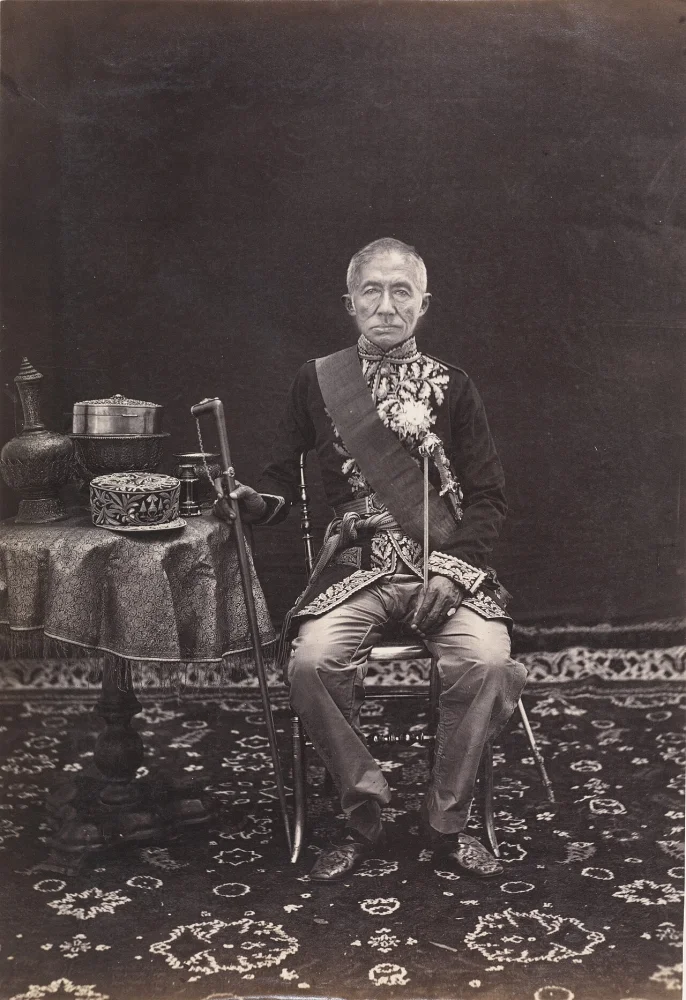
Mongkut spent nearly three decades as a Buddhist monk before becoming King of Siam at age forty-six. As Rama IV, he led the kingdom through a period of intense pressure from European imperial powers, negotiating new commercial ties while supporting reforms at home. He was also a serious student of astronomy, and his accurate prediction of a solar eclipse in 1868 became one of the most famous episodes of his reign.
A Prince Becomes a Monk
Mongkut was born on October 18, 1804, the son of King Rama II. When his father died in 1824, the throne passed to his older half-brother, who became King Rama III. Mongkut entered the Buddhist monkhood, a customary path for royal men, and remained a monk for twenty-seven years. During that time he studied Buddhist scripture and Pali, the language of the canon, while also learning English and engaging with Western missionaries and scholars.
His monastic years shaped both his religious outlook and his political experience. Mongkut became an advocate of stricter study and practice within Thai Buddhism and founded the Thammayut reform movement. He also learned about Western science, geography, and technology—knowledge that would prove useful when he entered a court increasingly concerned with European power.
When Rama III died in 1851, senior officials and members of the royal family invited Mongkut to leave the monkhood and become king. He took the throne as Rama IV. His younger brother Pinklao was given a powerful position as a kind of second king, reflecting the need to secure cooperation among influential court factions.
Diplomacy and Reform
Mongkut’s reign began as Britain and France expanded their influence across Southeast Asia. In 1855, he concluded the Bowring Treaty with Britain. The agreement opened Siam to wider international trade and reduced some royal controls over commerce, but it also imposed restrictions, including low fixed tariffs and extraterritorial privileges for British subjects. Similar agreements followed with other Western nations.
The treaty reflected a difficult calculation. Greater access to foreign commerce and technology could strengthen Siam, while concessions might help prevent a direct colonial takeover. Mongkut’s approach combined diplomacy with selective adaptation: the court engaged foreign teachers and technical advisers, developed roads and canals, and introduced new administrative practices. He also promoted legal protections for women and encouraged agricultural development. These measures did not amount to a complete transformation during his reign, but they helped prepare the ground for later reforms under his son.
A King Who Studied the Sky
Mongkut’s interest in astronomy was more than a courtly pastime. He studied European astronomical texts and carried out his own calculations. In 1868 he predicted the date and path of a total solar eclipse visible from the Gulf of Thailand. He traveled with a royal party and foreign observers to Wa Ko to view it; the eclipse occurred as he had forecast.
The expedition also exposed the king to disease. Mongkut contracted malaria and became seriously ill. He died on October 1, 1868, shortly after the eclipse, aged sixty-three. The eclipse did not kill him; the illness he contracted during the journey did.
Family and Legacy
Mongkut had many wives and children, as was customary for the Siamese royal household. His son Chulalongkorn succeeded him as Rama V and later carried out major reforms that strengthened the state. Mongkut’s own legacy is more complex than the familiar image of a ruler who simply “opened” Siam to the West. He made concessions under unequal treaties, but he also used diplomacy and selective modernization to preserve the kingdom’s independence at a moment when neighboring states were being colonized.
In popular culture, Mongkut is often associated with the musical and film The King and I. Those works are dramatized adaptations, not reliable biographies, and their portrayal has long been criticized in Thailand. The historical king was a scholar, religious reformer, and political strategist whose reign helped Siam navigate a dangerous international landscape.