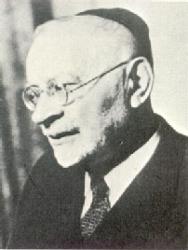
Mordecai Kaplan
 USA
USA- Early Life and Education
- Rabbinical and Teaching Career
- Establishment of Reconstructionism
- Intellectual Integrity and Jewish Tradition
- Reconstructionism: A Developing Civilization
- God in Reconstructionism: Naturalistic and Cosmic
- Historical Pragmatism and Jewish Tradition
- Major Works and Legacy
- Death and Legacy
Early Life and Education
Mordecai Kaplan, born in Lithuania and brought to the United States at the age of nine, initially received a traditional Jewish education. However, his exposure to non-orthodox perspectives in high school ignited a deep interest in religion and modern scholarship.
Rabbinical and Teaching Career
Kaplan graduated from the Jewish Theological Seminary in 1909 and began teaching there soon after. His nearly 50 years as an educator significantly influenced generations of Conservative rabbis.
Establishment of Reconstructionism
In 1922, Kaplan founded the Society for the Advancement of Judaism, the cornerstone of the Reconstructionist movement. The movement's journal, "Reconstructionist," established in 1935, played a vital role in disseminating Kaplan's ideas.
Intellectual Integrity and Jewish Tradition
In his teaching, Kaplan emphasized the importance of intellectual honesty in the face of scientific and philosophical challenges to traditional Jewish beliefs. Through his research on Midrash and Jewish philosophy, he combined deep scholarship with a practical application of Judaism to contemporary issues.
Reconstructionism: A Developing Civilization
Kaplan believed Judaism to be an evolving religious civilization, adaptable to changing circumstances. He saw its primary purpose as the meaning-making and value-creation for human existence, evident in religious behaviors, ritual, and communal engagement.
God in Reconstructionism: Naturalistic and Cosmic
Kaplan's religious concept was naturalistic, envisioning God as a cosmic force. He viewed Jewish religion as the expression of the Jewish people's moral aspirations. It rejected supernaturalism but embraced secular elements as integral to Jewish identity.
Historical Pragmatism and Jewish Tradition
Kaplan's approach to Judaism was both historical and pragmatic. He saw tradition as a guide rather than a constraint, emphasizing diversity and choice within Jewish denominations.
Major Works and Legacy
Kaplan's significant works include:- "Judaism as a Civilization" (1934)
- "The Meaning of God in Modern Jewish Religion" (1937)
- "Judaism Without Supernaturalism" (1958)
- "The Religion of Ethical Nationalism" (1970)
Criticism and Recognition
While Reconstructionism gained adherents, it faced criticism for its perceived abstraction and undermining of historical revelation. Conversely, Kaplan's advocacy for Zionist ideals and intercommunal connections earned respect and recognition.
Death and Legacy
Mordecai Kaplan passed away in 1983, leaving behind a legacy of progressive Jewish thought and a lasting impact on the American Jewish community. A synagogue in Jerusalem, Mevakshei Derekh, serves as a testament to his influence.