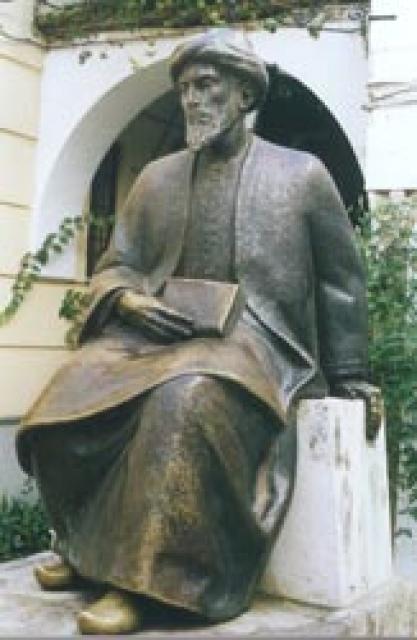
Moshe Maimonides
 Egypt
EgyptBiography of Moses Maimonides
Moses Maimonides was a Jewish philosopher, theologian, and Talmudist. He is known by many names in different languages and cultures. In European languages, he is known as Maimonides. In Hebrew literature, he is referred to as Rambam, an abbreviation for "our teacher Moses ben Maimon." In Arabic literature, he is known as Abu Imran Musa ben Maimun ibn Abd-Allah al-Qurtubi. In ancient Russian, he is referred to as Moses the Egyptian. His reputation spread not only within the Jewish world but also in the Muslim and Christian worlds. His works and his personality sparked heated debates and even led to book burnings and curses. The fact that civilized society still remembers and pays tribute to him eight centuries after his death speaks volumes about the magnitude and impact of his personality and contributions.
Moses Maimonides passed away in December 1204 in Cairo, where he served as the court physician to the sultan and leader of the Jewish community in Egypt. His remains were transported to Palestine and buried in Tiberias, where his tomb remains a pilgrimage site.
As a religious Jew, Maimonides formulated thirteen principles of faith, which became the basis for the prayer "Ani Ma'amin" (I believe). Even Jews facing death in Nazi concentration camps were said to have sung this prayer, with each part of the prayer beginning with the phrase "I believe." They would often sing the twelfth principle, expressing their unwavering belief in the arrival of the Messiah, even though they knew it was delayed. The belief in the coming of the Messiah is just one part of Maimonides' comprehensive set of dogmas. His other principles can be grouped into three main categories.
The first category includes beliefs about God, such as His existence, unity, incorporeality, eternity, and the prohibition of idolatry. The second category focuses on the law, prophecy, the uniqueness of Moses' prophecy, the divine origin of the written and oral law, and their eternal and unchanging nature. The third category encompasses beliefs about reward and punishment, God's omnipresence, divine retribution for good and evil, and, finally, the coming of the Messiah and the resurrection of the dead. In his famous book "Mishneh Torah," Maimonides presented these main dogmas of Jewish faith while also outlining the moral obligations that arise from these beliefs for every individual.
Maimonides was primarily known as an outstanding codifier of the Oral Law. By the 12th century, the Talmud, a multi-volume compendium of laws, moral teachings, and scientific knowledge, had become an enormous and disorganized collection. Moreover, the authors of the Mishnah and Gemara, the two parts of the Talmud, often contradicted each other, making it challenging to extract precise rules for everyday life. Maimonides set out to classify all Talmudic and post-Talmudic literature, and based on the Torah and Talmud, he compiled a complete code of Jewish laws and teachings, providing guidance for resolving disputed issues in the realm of law and ritual.
His monumental work, "Mishneh Torah," consisting of fourteen books, achieved this goal. It laid the foundation for subsequent codes, which regulated the lives of ordinary Jews and became essential for rabbis, judges, and community leaders. In fact, this book alone would have been enough to establish Maimonides as a leading figure in Jewish law. However, there is another significant work, "The Guide for the Perplexed" (Moreh Nevukhim), where Maimonides reveals the depth and sharpness of his philosophical thought.
What does this curious title mean? Maimonides explains that the purpose of this work is to encourage understanding of the true spirit of the law and guide those believers who, while remaining faithful to the Torah, study philosophy and are troubled by the contradictions between the truths of philosophy and the literal meaning of the Torah. This is the source of their perplexity.
The alternative translation of the title, which portrays the author's quest to reconcile the truths of revelation with the truths of reason, is "The Teacher for the Perplexed."
Besides his role as a religious philosopher, Maimonides also played the roles of a physician, scholar, and community leader. As a devout Jew, he revered the teachings of Moses and the prophets, while as a thinker, he acknowledged the teachings of Aristotle and other Greek philosophers. The main idea of his book is that pure religion and pure reason are in agreement. Both religion and reason recognize the existence of God as the cause or beginning of all existence and seek to elevate humanity to the highest perfection. Like other philosophers who shaped Western thought, such as Philo of Alexandria and Thomas Aquinas, Maimonides sought to harmonize the sacred world of Scripture with the Greek world encapsulated in various philosophical systems, reconciling Athens and Jerusalem.
"The Guide for the Perplexed" became the culmination of both Jewish theology and medieval Jewish religious philosophy. It was studied not only by Jews but also by Christians (in Latin translation) and Muslims.
Maimonides' life was filled with hardships and trials, characteristic of Jews in that era, which was marked by Islamic and Christian fanaticism. He was born in 1135 in Cordoba, a Muslim-dominated region of Spain, where his father served as a spiritual judge of the Jewish community and was a distinguished Talmudist. Jewish life in Spain at that time was intellectually vibrant, producing numerous great scholars, philosophers, and poets. Young Moses took full advantage of this environment for his education. He read extensively in Arabic and Hebrew and avidly studied the Talmud, philosophy, and natural sciences.
Unfortunately, Cordoba fell into the hands of Muslim fanatics known as the Almohads, and the family was forced to leave the city. They settled in Fez, in present-day Morocco, where they faced the same demand to convert to Islam or face death. To escape these threats, the family embarked on a perilous sea voyage to Palestine. However, they found themselves in a region controlled by the Crusaders, whose religious fanaticism rivaled that of the Muslims. Eventually, the family settled in Fostat, near Cairo, where some level of religious tolerance prevailed, and Saladin, the victor over the Crusaders, was known for his enlightened rule. Here, the family faced impoverishment, losing Moses' younger brother in a shipwreck along with all their possessions, which consisted of diamonds he used for trading. Moses had to find means of livelihood and became a physician, eventually receiving an invitation to the court of Saladin. It is said that Richard the Lionheart also extended a similar offer, but Maimonides chose the Muslim court over the Christian one.
The fate of Maimonides' works is remarkable. His comprehensive religious-philosophical system, reconciling Judaism and philosophy, marked a significant stage in the spiritual development of humanity, where rationality confronted mysticism and divine wisdom opposed human wisdom. Traditionalists saw his "Mishneh Torah" as an attempt to replace the study of the Talmud, which formed the essence of the many spiritual academies (yeshivas), with a systematic code that undermined Jewish spiritual knowledge.
However, even more disputes arose, both during Maimonides' lifetime and after his death, regarding "The Guide for the Perplexed" and its rationalistic philosophy. The debates revolved around the relationship between reason and philosophical thought on the one hand and faith and tradition on the other.
These disputes involved differences in religious and ethical beliefs. Maimonides' opponents accused his followers of having more respect for Greek philosophy than for Talmudic wisdom. They claimed that his followers disregarded religious prescriptions, convinced that they knew the secret meaning of these prescriptions, and accused them of exceeding the boundaries of permissibility in their allegorical interpretations of the Scriptures. In response, Maimonides' defenders claimed that opponents hindered the scientific and philosophical comprehension of nature and the Torah, which is the only source of religious knowledge. They argued that the opponents deviated from monotheism in their beliefs. This disagreement eventually led to the emergence of Kabbalah, a great mystical teaching that absorbed anti-Aristotelian elements from Neoplatonism, as a response to the spread of Maimonides' rationalism. It was a perpetual struggle between faith and reason, which has continued in various intellectual forms to this day.
It is worth noting that in the 20th century, Jewish thought gave rise to the theory of the opposition between two principles in the national Jewish history: the democratic religion of sentiment and the intellectual aristocracy of rationalism. If in the 13th century, opponents of Maimonides criticized him for his philosophy and the dry scholasticism of the Talmud, then in the 16th-18th centuries, this opposition was reflected in the writings of Spinoza on one side and in messianic movements and Hasidism on the other. One can continue with such comparisons, recalling that in recent times, the messianic aspirations of the Jewish people were embodied in political Zionism, and Jewish thought gave birth to the religious existentialism of Shestov and Buber.
In conclusion, Maimonides' literary legacy is becoming increasingly accessible to Russian-speaking readers. The revival of Jewish thought and culture in Israel and Russia has led to the emergence of schools of philosophers, historians, and theologians who have worked to produce new translations of Maimonides' works.