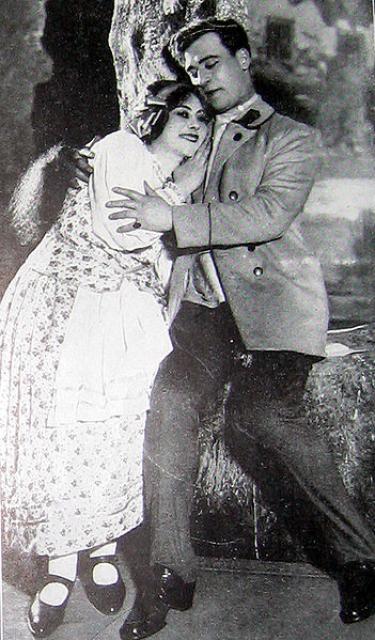
Moyshe Finkel
 USA
USABiography of Moishe Finkel
Moishe Finkel was a Jewish actor and one of the most influential entrepreneurs of the early Yiddish theater. He was born and raised in Kishinev, Moldova. In 1876, after being impressed by the first Jewish troupes from Romania that toured the city, Finkel became interested in theater and was accepted into Avrum Goldfaden's troupe, the founder of modern Jewish theater.
After a year, Isruel (better known as Srulek) Grodner separated from Goldfaden's troupe and invited Finkel and his wife, Anetta Schwartz (Finkel), who was also an actress, to join his new company in Iasi. The couple worked with Grodner until the end of the 1880 theater season, and in the following season, they traveled with another star of the early Yiddish theater, Yakov Spivakovski, through towns in Bessarabia and southern Ukraine.
In the next theater season, Finkel formed his own troupe called the "Society of Jewish Operetta and Drama Artists under the direction of M. Finkel." On May 3, 1883, they began touring in Rostov-on-Don. Their repertoire was almost identical to the previous season's repertoire of Lerner's troupe. It included plays by N. M. Shaikewich, other authors, and specially created performances for Anetta Finkel.
However, in September of the same year, theater performances in "Jewish jargon" were prohibited in Russia by a resolution of the deputy minister of internal affairs, General-Lieutenant Orzhevsky, and most actors went to neighboring Romania. In Bucharest, Finkel and Zeylik Mogulesko established a joint troupe that mainly focused on operetta and musical comedy. The troupe performed in Jignita Street and in the summer garden on Kalia Vekeresht. They regularly went on tour to Iasi, Botoshani, and Galati.
Due to disagreements with Mogulesko, Finkel briefly managed the troupe himself, but without much success, as Mogulesko was the beloved favorite of the audience. By the next season, Mogulesko was invited back. In 1886, Mogulesko visited New York and settled there with the main cast of the troupe, including Finkel, Kessler, Fainman, and Blank. In New York, Morris Finkel continued to work with Sigmund Mogulesko, managing his troupe, which was initially based in the Union Theatre.
On the crest of their overwhelming success, Mogulesko and Finkel separated in 1889. Mogulesko founded the "Roumanian Opera House" with a focus on vaudeville and operetta, while Finkel, who initially managed and directed the Romanian Opera House and the Thalia Theater, soon created his own company, the National Theatre, and began selecting actors.
In the mid-1890s, Finkel recruited Boris Tomashewsky from Philadelphia and introduced him to the wider public. Tomashewsky became a leading artist at the National Theatre and later became Finkel's full partner. In the early 1890s, Finkel divorced his first wife, Anetta Schwartz, and in 1893, he met and began a romance with Boris Tomashewsky's sixteen-year-old sister, Emma, who was singing in the choir of the National Theatre.
Finkel and Emma ran away to Philadelphia, where they got married and started a family. They lived in Philadelphia until the late 1890s, working in the local Jewish theater. Upon returning to New York, Finkel, together with another Jewish stage star, Jacob Adler, embarked on the construction of the Grand Theatre, the first purpose-built Jewish theater in the country, located on the Bowery on Grand Street.
The Grand Theatre opened its doors in 1903, but a legal dispute between Adler and Finkel over the management of the troupe began that same year. By the end of the year, the court ruled in favor of Adler, who received Finkel's share, leaving Finkel completely out of the theater business. To make matters worse for Adler, despite everything, Finkel invited Emma back to the Grand Theatre for the next season, and she accepted.
Rumors began circulating in theatrical circles about Emma's affair with another actor of the troupe, David Levinson, and that Finkel had allegedly hired a private detective to spy on his unfaithful wife. In mid-1904, Emma even filed for divorce from Finkel. On June 7, 1904, at a summer theater retreat in New Jersey, Morris Finkel attempted to shoot Emma, who was sitting on a park bench with Levinson, and then took his own life.
Emma survived but was left paralyzed from the bullet wound to her spine. She remained confined to a wheelchair for the rest of her life and died at the age of fifty-two in 1929. The tragedy that unfolded shocked the theatrical world of the city and dominated the front pages of New York newspapers for a week until June 15 of the same year when it was finally overshadowed by a fire on the General Slocum steamship that claimed over a thousand lives.
Finkel's son from his first marriage to Anetta Schwartz, Abe Finkel, worked as a director in Broadway theaters and later became a renowned Hollywood screenwriter. His daughter, Lucy Finkel, was an actress at the Yiddish Art Theatre in the 1920s and 1930s. Bella Finkel, another daughter, married Meshilem Meier Weisenfreund (later known as Paul Muni) and also pursued an acting career in Yiddish and English theaters.
Bella and Meshilem moved to Los Angeles in 1929, where Meshilem signed a contract with Fox Studios and became one of the main stars of Hollywood under the name Paul Muni. Together with her brother, Bella co-wrote the screenplay for the film "The Deceiver" (1931). They continued to act in Irving Place Theater and other theaters in New York's Lower East Side, as well as in English-language productions on Broadway.


