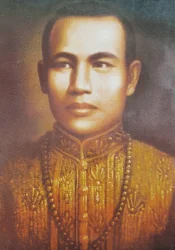
Muhammad Shaybani
- A Royal Line and a Difficult Start
- The Conquest of Transoxiana
- A Ruler, Patron and Poet
- The Safavid Challenge and Death at Merv
- Legacy
Muhammad Shaybani Khan rose from a precarious childhood on the steppe to become one of the most formidable rulers of Central Asia. In a series of campaigns, he displaced the Timurids from Samarkand and Bukhara, expanded into Khwarazm and Khorasan, and founded the Shaybanid dynasty. He was also a poet and author who wrote in Chagatai Turkic. His empire-building ended abruptly near Merv in 1510, when he was defeated and killed by Shah Ismail I of the Safavid dynasty.
A Royal Line and a Difficult Start
Born around 1451, Shaybani was the son of Budaq Sultan and grandson of Abu’l-Khayr Khan, a leading ruler of the Uzbek ulus. Through the line of Shiban, a son of Jochi, his family claimed descent from Genghis Khan. Such ancestry carried political weight in Central Asia, where Chinggisid lineage helped legitimize rule.
Shaybani was orphaned while young. He and his brother depended on loyal retainers and patrons as political rivals pursued the remnants of their family’s power. He studied at a madrasa in Bukhara and gained experience serving as a military leader for Timurid and neighboring rulers. These years gave him a close view of the weakness dividing the Timurid territories.
The Conquest of Transoxiana
By the late 1480s, Shaybani had established a base around Turkestan, capturing towns including Sayram and Otrar. His first attempt to take Samarkand failed, but he returned to the struggle with growing support among Uzbek tribes. He captured Bukhara in 1499 and Samarkand around 1500, overcoming the Timurid ruler Sultan Ali Mirza.
The conquest drew him into a long rivalry with Babur, a Timurid prince who would later found the Mughal Empire in India. Babur briefly regained Samarkand, but Shaybani defeated him in 1501 and secured the city. Their contest was more than a personal feud: it marked the end of Timurid power in much of Transoxiana and the rise of a new Uzbek ruling house.
Shaybani pushed further across Central Asia. His forces took Khwarazm after a lengthy siege of Urgench, captured Balkh, and entered Herat in 1507, displacing the Timurids’ principal southern center. His realm spanned Transoxiana, Khwarazm and much of Khorasan. He governed through grants of conquered territories to sons, relatives and tribal leaders, and introduced a uniform silver coinage in major cities.
A Ruler, Patron and Poet
Shaybani’s rule included a religious and cultural program alongside conquest. He presented himself as a defender of Sunni Islam in a region where the Safavid state promoted Shiism. His court attracted scholars and clerics, and he supported the construction of mosques and madrasas in cities including Bukhara, Samarkand and Tashkent.
He also wrote poetry and prose in Chagatai Turkic under pen names including Shahbakht and Shayboq. Works attributed to him include the poem Bahr al-Huda, completed in 1508, and a counsel text for his heir. His literary activity complicates the image of a ruler known principally for campaigns: he took part in the Turkic literary culture of the courts he governed and addressed political and religious themes in his writing.
The Safavid Challenge and Death at Merv
The expansion of Shaybani’s power brought him into direct conflict with Shah Ismail I, founder of the Safavid dynasty. In 1510 Ismail advanced into Khorasan. Shaybani withdrew to Merv, where his forces were outnumbered and confined. According to accounts of the battle, the Safavid army drew the Uzbeks out with a feigned retreat and then defeated them in the open.
Shaybani was killed near Merv on December 2, 1510. His death was a severe blow, but the polity he created did not vanish with him. His relatives continued the dynasty, which ruled in Transoxiana for much of the sixteenth century.
Legacy
Shaybani’s career reshaped the political map of Central Asia. He ended Timurid rule across a wide region, established the Shaybanid dynasty and secured a durable Uzbek presence in Transoxiana. The dynasty’s later rulers made Bukhara a major center of power and culture.
His legacy combines political ambition with literary and religious authority. He was a conqueror who understood the value of dynastic legitimacy, a ruler who promoted institutions in the cities he took, and a poet who wrote for his own courtly world. Defeat at Merv cut his life short, but the dynasty and political order he founded outlasted him by generations.