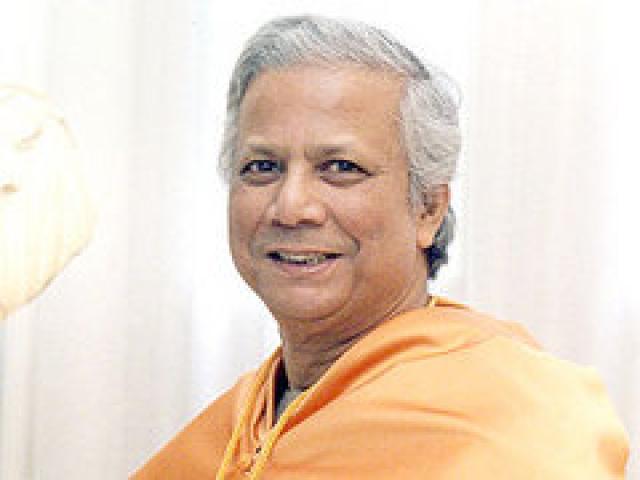
Muhammad Yunus
 India
IndiaBiography of Muhammad Yunus
Muhammad Yunus, born on June 28, 1940, in Chittagong, Bengal, India, is a Nobel Peace Prize laureate for the year 2006 and a professor of economics. He is the creator of Grameen Bank, a bank that pioneered microcredit lending to landless poor people and helped to improve the lives of millions of people in Asia. Yunus is also the author of the concept of "village government," which aims to increase income from agricultural activities by investing a portion of the earnings from crop sales into infrastructure development.
Yunus was born into a family of nine children. His father, Muhammad Dula Meah, was a trader of gold jewelry. Yunus attended Baluardighi Elementary School, where he excelled and received the highest scores in the city for the fourth-grade exams. One of his teachers recommended that he transfer to the prestigious Middle English School in Chittagong to complete the fifth and sixth grades. Yunus continued his education at Chittagong Collegiate School, where he graduated in 1955, ranking fifteenth among the 39,000 students in the province.
In 1952, Yunus had the opportunity to participate in the World Scout Jamboree in Canada. This allowed him to visit not only Canada but also New York, Washington, and Europe, including a bus journey through Europe and the Middle East.
After returning, Yunus enrolled in Chittagong College, where he pursued a humanities program. In 1957, he entered the University of Dhaka and attended the World Scout Jamboree in the Philippines and the All Japan Jamboree in Japan in 1958, during which he visited Saigon, Hong Kong, Bangkok, and Rangoon. Yunus received his bachelor's degree from the University of Dhaka in 1960 and completed his diploma in economics in 1961. He then returned to Chittagong College to teach economics.
In 1964, Yunus applied for a Fulbright Scholarship and was admitted to Vanderbilt University in Tennessee. He attended preparatory courses for foreign students in economics at the American Economic Association's Economic Institute in Colorado in the summer of 1965. He then passed the U.S. Graduate Record Exam with a score of 98 out of 100 and began working on his doctoral dissertation, "Intertemporal Allocation of Resources," at Vanderbilt. Even before completing his dissertation, Yunus taught at the University of Colorado in Boulder in 1969 and became an instructor at Tennessee State University in 1970, where he worked until 1972. After Bangladesh's independence was declared, Yunus returned to Dhaka and then Chittagong, where he became the head of the economics department.
In Chittagong, Yunus organized an agricultural program for efficient irrigation in the village of Jobra. He introduced the "one-third system," where one-third of the crop revenue would go to landowners, one-third to the peasants, and one-third to infrastructure development, particularly irrigation. The landless peasants were the most active participants in this experiment, as they had nothing to lose. The first trial tripled the rice crop, but it also revealed the need for strict control over the one-third allocation, as theft caused it to be lower than intended. Yunus received a presidential award in 1978 for the implementation of the "one-third system" program in 1977. In 1985, he received the Central Bank of Bangladesh Award, and in 1987, he received the highest state award on Independence Day.
In 1976, Yunus convinced Janata Bank to provide loans in his name to finance the rural population. This led to the establishment of Grameen Bank Prakalpa, a project that provided loans to landless poor people, mostly women. The bank aimed for full repayment of loans in small installments and required borrowers to come in groups of five to ten people. Yunus also introduced a savings method among groups of borrowers, which essentially created a mutual assistance fund. The repayment rate reached 99 percent.
In 1977, two other banks launched similar credit programs, including the Agricultural Bank in Dhaka. In 1974, Yunus came up with the idea of "village government" (Gram Sarker), which was approved by the Bangladesh government in 1980. In the same year, Yunus became a member of the country's delegation to the United Nations General Assembly.
In April 1980, Yunus married Dr. Afrozi Begum, a physicist from Jahangirnagar University.
From 1993 to 1995, Yunus served as a member of the International Advisory Group at the Fourth World Conference on Women in Beijing, as appointed by the UN Secretary-General. During the same period, he worked with the Global Commission of Women's Health. Since 1993, Yunus has been a member of the Advisory Council for Sustainable Economic Development. He is also part of the UN Expert Group on Women and Finance.
In 2006, Yunus and Grameen Bank received the Nobel Peace Prize for their efforts to initiate grassroots economic and social development. He has also received several international awards, including the Ramon Magsaysay Award in Manila (1984), the Aga Khan Award for Architecture in Geneva (1989), the Mohamed Shabdeen Award for Science in Sri Lanka (1993), and the World Food Prize in the United States (1994).
Yunus has been involved in various organizations, including the Economic Association of Bangladesh and the Bangladesh Institute of Development Studies. He serves on the boards of many international organizations, including Amanah Ikhtiar Malaysia, a project inspired by Grameen Bank.