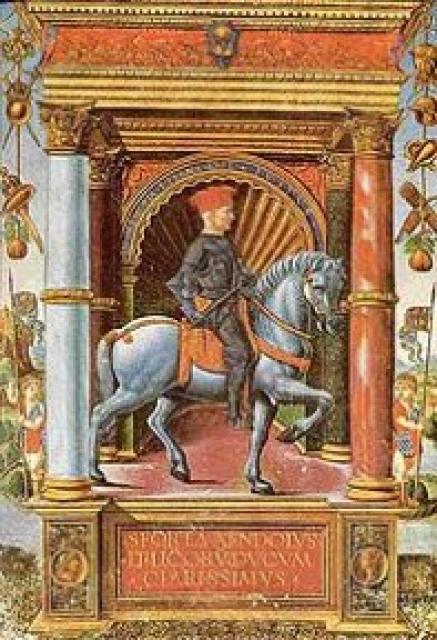
Muzio Attendolo
 Italy
Italy- Muzio Attendolo Sforza: The Founding Father
- The Making of a Condottiere
- Service and Intrigue
- Neapolitan Ambitions and Misfortune
- Military Engagements and Untimely Demise
- Marriages and Descendants
Muzio Attendolo Sforza: The Founding Father
Muzio Attendolo Sforza, the progenitor of the mighty Sforza dynasty, was born in 1369 within the affluent Attendolo family in the village of Cotignola, Romagna. Baptized Giacomo, his nickname "Muzio" was derived from the diminutive "Giacomuzzo."
The Making of a Condottiere
At the tender age of 15, Muzio joined the ranks of the condottiero Boldrino da Panicale. Legend has it that as passing soldiers beckoned him to join them, Muzio hurled an axe, vowing to follow them if it lodged in a tree, and to remain if it fell to the ground. This anecdote would become a family legend, with Duke Francesco Sforza later attributing his grand Milanese castle to the fateful axe that had become embedded in a tree.
For the next 15 years, Muzio served with the renowned condottiero Alberico da Barbiano in the company of Saint George, earning the moniker "the Strong" (Sforza in Italian). He was known for his exceptional physical prowess, capable of bending horseshoes and mounting into the saddle fully armed.
Service and Intrigue
Muzio's military prowess led him into the service of Gian Galeazzo Visconti, but accusations of slander forced him to flee Milan. He subsequently served Florence, Ferrara, and Rome, with the Pope granting him the fiefdom of his hometown, Cotignola.
Neapolitan Ambitions and Misfortune
Muzio then entered the service of King Ladislaus of Naples, who took his son, Francesco, as a hostage and raised him alongside the royal princes. The king bestowed upon young Francesco several towns and made him Count of Tricarico. However, upon the accession of the new queen, Joanna II of Naples, Muzio's fortunes shifted. Accused by one of the queen's jealous favorites, Alope, Muzio was imprisoned for four months. Desperate for military support, Alope released Muzio and married him to his sister. Yet, when the queen remarried, Alope fell from favor, nearly dragging Muzio down with him.
Military Engagements and Untimely Demise
In the ensuing years, Muzio clashed with the condottieri Terzi, Braccio, and Tartaglia. He aligned himself with Louis of Anjou in his struggle against Queen Joanna. During a skirmish with Braccio, Muzio drowned while crossing the Pescara River. His legacy was carried forward by his son, Francesco.
Marriages and Descendants
Despite having at least seven children with his mistress Lucia Terzagni (also known as Lucia di Terzano), including Francesco and Alessandro Sforza, Muzio arranged her marriage to one of his officers before marrying. In 1409, he wed Antonia, the sister of Count Salimbeni, ruler of Cortona. His legitimate wife bore him a son, Bosio, who was tragically murdered in his youth, but left descendants through his marriage to Cecilia Aldobrandeschi, heiress of the Counts of Santa Fiora in Tuscany. Bosio's lineage ruled Tuscany until the mid-17th century, outliving all other branches of the Sforza family. Muzio's second marriage was to Pandolfo Alope's sister, Catella (Caterina), with whom he had two children. His third and final marriage, to Maria, the widowed Countess of Celano, produced a son named Gabriel, who later entered monastic life.