Mario Savio
 USA
USAMario Savio: An American Activist and Human Rights Fighter
Mario Savio was an American activist and champion of human rights who became one of the most prominent figures in the counterculture movement of the 1960s. He gained widespread recognition for his impassioned speeches advocating for freedom of speech in Berkeley, California. Born on December 8, 1942, in New York City, Savio came from a family of Italian immigrants. His father worked in a steel factory and had hopes of his son becoming a priest, given Mario's involvement in church activities during his childhood.
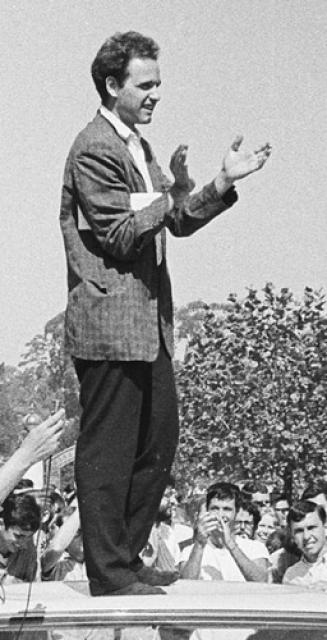
However, Mario had different aspirations and did not intend to follow the path predetermined by his parents. Instead of embracing the humility preached by the church, he chose the path of activism. After moving to Berkeley, California, Savio struggled to find meaningful employment like many other Americans. He faced hardships at the hands of both government agencies and greedy employers. It was during his interactions with students at the University of California, Berkeley that he found like-minded individuals who shared his interests.

Interestingly, Savio's career as a freedom fighter began almost by chance. On October 1, Jack Weinberg set up a table for the Congress of Racial Equality, but he was soon arrested by the police. At one point, someone from the crowd of students shouted, "Sit down!" Savio found himself among the few protesters who sat at the table for the next 32 hours until the university administration made concessions. During this time, Mario began engaging in conversations with the students, and to his surprise, the dialogue turned into a monologue that not only captivated hundreds of protesters but also university staff and random passersby.
As Savio conversed with the students, he eventually removed his shoes and continued speaking from the roof of a parked car. Hours later, following a conversation with the university president, he emerged before the awaiting crowd, removed his shoes again, climbed onto a police car, and asked the students to disperse with dignity. To the surprise of the police, none of the protesters dared to argue.
Over the next few years, Mario Savio remained a significant figure in the emerging Free Speech Movement and various other organizations. His speeches were broadcasted on the radio and transcribed by students fortunate enough to be present at the demonstrations. In 1965, he married Suzanne Goldberg, whom he had met within the Free Speech Movement. After their marriage, Savio's participation in public life waned, although he ran unsuccessfully as a senatorial candidate for the newly-formed Peace and Freedom Party.
On November 2, 1996, Mario Savio was admitted to a hospital in California due to heart problems. He soon fell into a coma and passed away on November 6. Three years after his death, in 1999, the FBI declassified surveillance records on Savio, citing him as the "most visible student leader." Civil rights advocates discovered multiple infringements, including the absence of a warrant for surveillance, the collection of personal information, and his inclusion on a list of individuals to be detained in the event of a national emergency.