Muzio Clementi
 Italy
Italy- Biography of Muzio Clementi
- Early Life and Education
- Years in England
- European Tour and Competition with Mozart
- Later Years and Legacy
Biography of Muzio Clementi
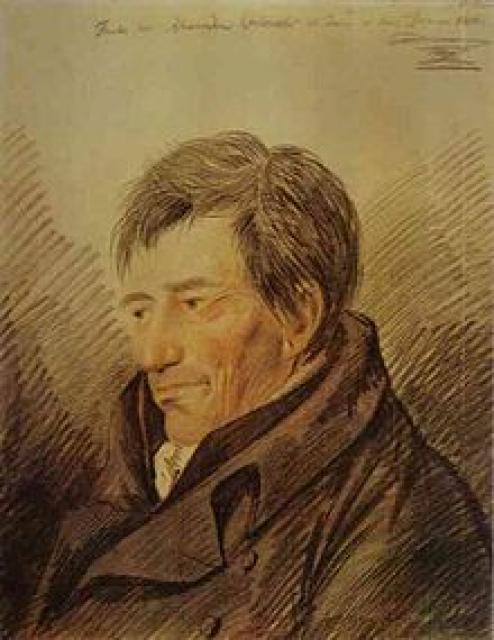
Muzio Filippo Vincenzo Francesco Saverio Clementi, an Italian composer, pianist, pedagogue, conductor, music publisher, editor, and piano manufacturer, was born on January 24, 1752, in Rome, Italy. He spent most of his life in England. Clementi is best known as the author of a series of piano sonatas and a collection of piano compositions called "Gradus ad Parnassum." 19th-century enthusiasts referred to Clementi as the "Father of modern piano technique" and praised his "romantic piano virtuosity," although they noted that his works sometimes lacked sincerity and emotional depth.
Early Life and Education
Muzio Clementi was the eldest of seven children born to Nicolo Clementi, a respected silversmith, and his wife Magdalena Kaiser. Recognizing his son's musical talent at an early age, Nicolo arranged for private lessons with Antonio Baroni, a cathedral choir master. By the age of seven, Clementi began studying the organ, followed by vocal lessons, and later counterpoint. At the age of thirteen, he already composed an oratorio called "Martitio de' gloriosi Santi Giuliano" and a mass. When he turned fourteen, he obtained the position of organist at the San Lorenzo in Damaso parish where he was baptized.
Years in England
In 1766, Peter Beckford, a wealthy Englishman twelve years older than Clementi, visited Rome. He was so impressed by the young Clementi's talents that he offered to take him to England, settle him in his estate in Dorset, and fund his further musical education until the age of twenty-one. Consequently, for the next seven years, Clementi lived, performed, and studied in Dorset, spending up to eight hours a day practicing the harpsichord. In 1770, he made his first public appearance as an organist. The audience was highly impressed by his playing, and this performance marked the beginning of one of the most remarkable musical careers of his time.
In 1774, Clementi was released from his obligations to Beckford. In the winter of 1774-1775, he moved to London and made his debut as a harpsichordist on April 3, 1775. He continued to perform in concerts, conducted at the King's Theatre, worked on his compositions, and his popularity grew. It was in 1779 and 1780 that Clementi achieved significant success, mainly due to the high sales of his "Opus 2 Sonatas." In musical circles, there were whispers that Clementi was perhaps the greatest pianist of his time and even of all time.
European Tour and Competition with Mozart
In 1780, Clementi embarked on a three-year European tour, stopping in Paris, where he performed for Queen Marie Antoinette, Munich, and Salzburg. In Vienna, he agreed to participate in a musical competition with Mozart for the entertainment of Joseph II, the Holy Roman Emperor, and his guests. The competition, held on December 24, 1781, involved the composers improvising and performing excerpts from their own works. The emperor diplomatically declared it a draw. Mozart later wrote to his father, praising Clementi's playing but criticizing it as mechanical, lacking taste or feeling. Clementi, on the other hand, was genuinely impressed by Mozart's improvisations and admired him for a long time, often sharing his admiration with others. Despite later attempts by some researchers to portray them as rivals, there were no particular reasons for this. Indeed, at that time, Clementi possessed a more virtuosic and brilliant style, catering to the public, which partially explains Mozart's dismissive attitude. On the other hand, Mozart used themes from Clementi's Sonata Op. 24, No. 2 in the overture of his opera "The Magic Flute," which can be seen as a compliment. Additionally, some of Clementi's later works incorporated certain piano effects clearly of foreign origin, which most likely emerged under the influence of Clementi's works. Clementi himself forever retained his admiration for the Austrian composer.
Later Years and Legacy
In 1783, Clementi returned to England and remained there for the next 20 years, performing, conducting, teaching – some of his students became highly renowned musicians and composers – and gradually shifting his focus from performance to composition. On January 24, 1813, Clementi, alongside a group of prominent musicians, founded the Philharmonic Society of London, which later evolved into the Royal Philharmonic Society in 1912. His piano business thrived, and as an inventor and skilled mechanic, he made several important improvements to the construction of the piano that are still used today.
Clementi spent his final years in Evesham, Worcestershire, and passed away on March 10, 1832, at the age of 80, after a brief illness. He was married three times and reportedly had four children.