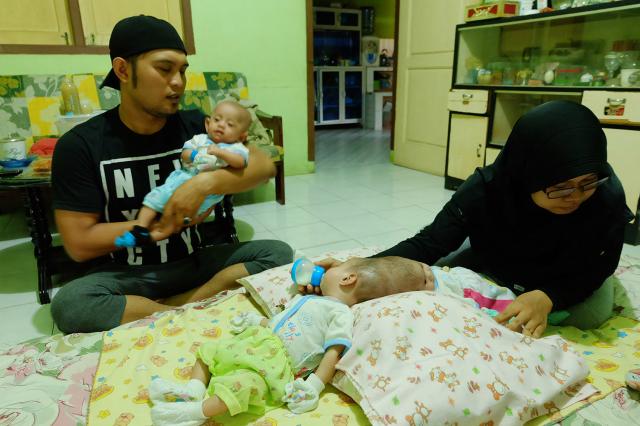
Nadira Alifa and Nadiba Aisyah Putri
 Indonesia
- Siamese Twins from Indonesia
- A Challenging Birth
- Waiting for the Operation
- The Challenges and Risks of Separation
Siamese Twins from Indonesia
The twin girls are connected by a shared head, but each has her own brain and individual personality. Sisters Nadira Alifa and Nadiba Aisya Putri were born on February 21, 2016, with a common skull but separate brains. The girls were delivered by caesarean section at the general profile Tandjungpinang Regional Hospital in Indonesia.

A Challenging Birth
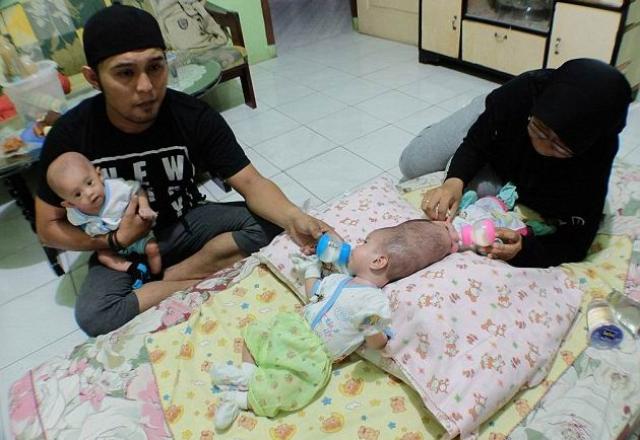
In reality, Nadiba and Nadira were part of a set of triplets. Their sister, who appeared perfectly healthy, was delivered without any major issues. However, the conjoined twins faced a more complicated situation. The girls' parents, City Nuryaningsih and Juarnes Prana Dinata, who are both thirty years old, eagerly await a highly complex operation that will separate their conjoined daughters. Without the separation, the girls will not be able to lead a normal life. Mr. Dinata stated, "The doctors were shocked during the birth process when they realized they were dealing with triplets and conjoined twins at the same time. I am glad that all the babies are healthy, but I cannot wait for Nadira and Nadiba to be separated. It is really difficult for me and my wife to see the condition our daughters are in." City added that even now, it is evident how different the twins are from each other in terms of character, despite their shared skull. She said, "They are still too young to make any decisions, but you can see what each of them wants in every moment. That is why we believe that attempting the separation operation is the necessary step to take. When one of the daughters is asleep, the other wants to play, so this mismatch causes a lot of inconvenience. We really hope for the separation of our babies."
Waiting for the Operation
The twins were transported to the hospital in Jakarta. The doctors advised the parents to be patient because the girls need to gain weight before serious consideration can be given to the operation. However, Mr. Dinata expressed dissatisfaction with this news, saying, "The expectations were not met because the doctors at the hospital in Jakarta were unable to perform the separation operation. They will wait until my daughters gain at least 10kg. We hope that the children will be able to gain the necessary weight within the next 6-8 months."

The Challenges and Risks of Separation
Siamese twins occur in approximately one in every 200,000 births. The University of Maryland Medical Center reports that about 40-60% of siamese twins are stillborn, and in approximately 35% of cases, the twins do not survive beyond one day. The survival of twins who undergo separation surgery depends on the type of connection and the internal organs that need to be separated. There is no known case where siamese twins with fused heart chambers, ventricles, have been successfully saved. While separation of conjoined twins has become more successful in recent years, it remains a rarity. Since 1950, at least one of a pair of siamese twins has survived in 75% of cases after separation. The separation of siamese twins is a delicate and risky procedure that requires extreme precision and carefulness. Only after the birth of the twins can doctors use magnetic resonance imaging, ultrasound, and angiography to determine which organs they share. To assess the feasibility of separation, doctors must carefully evaluate the functioning of the shared organs. Most twins require intensive rehabilitation after separation due to defects and dangerous positions assumed by the separated pairs of lumbar vertebrae. Their back muscles are constantly bent, and it is often difficult for the twins to bend forward and sit upright.


