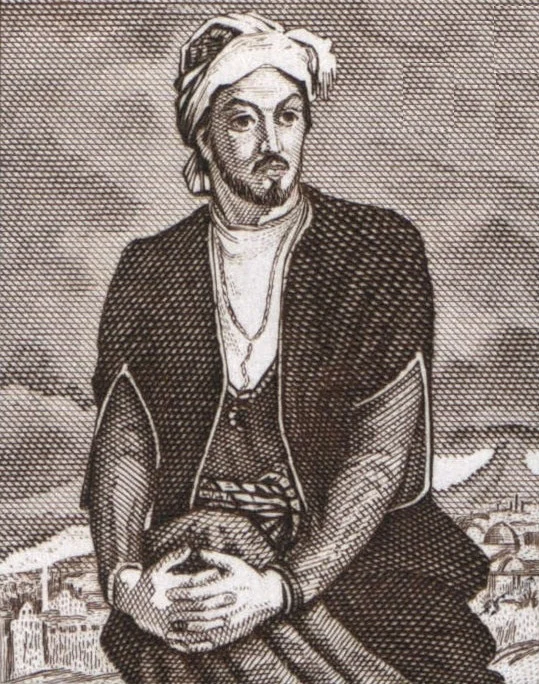
Nasimi
Nasimi was a major poet of the late fourteenth and early fifteenth centuries whose verse joined lyric intensity with the mystical ideas of Hurufism. He wrote in Azerbaijani, Persian, and Arabic, helping establish Azerbaijani as a language of sophisticated literary expression. His life is partly obscured by later tradition, but his poetry and his association with the Hurufi movement left a lasting mark across the Turkic-speaking world.
Early life and education
Known by the pen name Nasimi, he is often identified by the fuller name Imadaddin Nasimi. He was born around 1369 or 1370, but accounts differ about his birthplace. Shamakhi in Shirvan, in present-day Azerbaijan, is the most common identification, while other traditions associate him with places such as Tabriz, Baghdad, or elsewhere.
Nasimi lived during a period of political and religious change across the Middle East. He studied Islamic learning and became a follower of Fazlallah Astarabadi, the founder of Hurufism. The movement taught that letters, numbers, and the human face carried layers of divine meaning, and that careful interpretation could reveal truths about creation and the human place within it.
Poetry and Hurufi thought
Nasimi gave Hurufi ideas memorable poetic form. His verses combine images of beauty, love, and spiritual longing with claims about the depth and dignity of human existence. At times his poetry speaks in a bold, even startling voice, presenting the human being as a mirror of divine signs. This language was grounded in a mystical theology, but it also gave his poems a powerful sense of personal presence.
He composed poetry in Azerbaijani, Persian, and Arabic, reflecting the multilingual literary culture of his era. His Azerbaijani poems are especially important in the development of classical poetry in that language. Nasimi’s command of rhythm, metaphor, and wordplay allowed abstract ideas to become vivid and emotionally charged, helping his work travel beyond the circles of formal religious study.
Travels and persecution
After Fazlallah Astarabadi was executed in 1394, Nasimi continued to spread Hurufi teachings. He traveled through Anatolia and other regions before settling in Aleppo, then under Mamluk rule. His ideas attracted followers but also drew opposition from religious authorities who regarded Hurufism as unacceptable.
Nasimi was executed in Aleppo around 1417 or 1418. Later accounts say that he was flayed alive for his beliefs, and this became the defining story of his martyrdom. The exact circumstances remain debated: sources vary in their details, and some scholars caution that the dramatic account of his skinning may have been shaped by later legend. His death nevertheless came to symbolize the risks faced by a poet who openly defended an unorthodox mystical path.
Legacy
Nasimi’s poems continued to circulate and were preserved in collections across several languages. His work influenced later Azerbaijani and broader Turkic poetry, while his daring treatment of faith, the body, and human dignity made him a lasting cultural figure. Readers have approached him both as a major lyric poet and as a spiritual thinker.
In Azerbaijan, he is honored as one of the foundational figures of national literature, and his name remains associated with the cultural history of Shamakhi and Shirvan. Beyond that legacy, Nasimi’s poetry still stands out for its directness: it asks readers to find profound meaning in language, in the visible human form, and in the restless pursuit of truth.