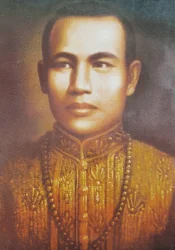
Sayat-Nova
- Early Life and Musical Training
- At the Court of Heraclius II
- Poetry Across Languages
- Priesthood and Final Years
- Legacy
Sayat-Nova was an eighteenth-century poet, singer, and instrumentalist whose songs crossed the linguistic and cultural boundaries of the Caucasus. Born Harutyun Sayatyan in Tiflis, he became known as an ashugh, a poet-musician who performed verse to music. His surviving works in Armenian, Georgian, and Azerbaijani preserve a rare portrait of a multilingual court culture.
Early Life and Musical Training
Sayat-Nova was born in Tiflis, now Tbilisi, on 14 June 1712. The city brought Armenian, Georgian, Persian, and Turkic-speaking communities into close contact, and that diversity became central to his artistic life. Details of his childhood are scarce, but his own poetic notes describe learning instruments and developing his musical skill from a young age.
He became accomplished on the kamancha, a bowed string instrument, as well as the chonguri and tambur. As an ashugh, he did more than write lyrics: he sang and played them for audiences, drawing on the rhythmic patterns, imagery, and verbal virtuosity of a broader Persianate poetic tradition.
At the Court of Heraclius II
Sayat-Nova performed at the court of Heraclius II, king of Kartli and Kakheti. His artistry made him a prominent court singer, and his poems celebrated love, beauty, longing, and the tensions of human life. The claim that he also served as a diplomat appears in some accounts, though the surviving evidence for his exact official duties is limited.
Tradition tells of a romance between the poet and a royal woman, often identified as the king’s sister, that supposedly caused his expulsion from court. The story has become part of his popular biography, but historians have cautioned that its details are uncertain and may blend later legend with fragments of his own poetry.
Poetry Across Languages
Sayat-Nova’s artistic legacy is unusually multilingual. Songs attributed to him survive in Armenian, Georgian, and Azerbaijani, with some Persian pieces also associated with his work. The precise number of surviving poems varies by scholarly edition, but his manuscript record shows a poet comfortable moving between languages and scripts. In some pieces, different languages appear together, underscoring the mixed literary environment in which he worked.
Many of his lyrics are love songs, but the work also includes spiritual reflection and expressions of loss. His combination of musical craft, intricate rhyme, and emotionally direct imagery helped make him one of the most celebrated ashughs of the region. The poems were performed and copied, and later generations passed many of the songs through oral tradition.
Priesthood and Final Years
In the later part of his life, Sayat-Nova entered the Armenian Apostolic Church. He served as a priest and, after his wife Marmar’s death in 1768, took monastic vows at Haghpat Monastery. He continued religious and literary work there, including copying manuscripts. The couple had four children.
In 1795, the Qajar ruler Agha Mohammad Khan invaded Georgia and sacked Tiflis. Sayat-Nova died that year, probably during the invasion, though accounts differ over the precise circumstances and location. A later tradition says he was killed after refusing to renounce Christianity; this story has given him a martyr’s aura, but the details cannot be established with certainty.
Legacy
Sayat-Nova is claimed as a major cultural figure in Armenian, Georgian, and Azerbaijani literary histories. That shared inheritance reflects the multilingual world in which he composed and performed, rather than a simple modern national category. His songs continue to be sung, adapted, and studied as a remarkable meeting point of poetry, music, and the cultures of the Caucasus.