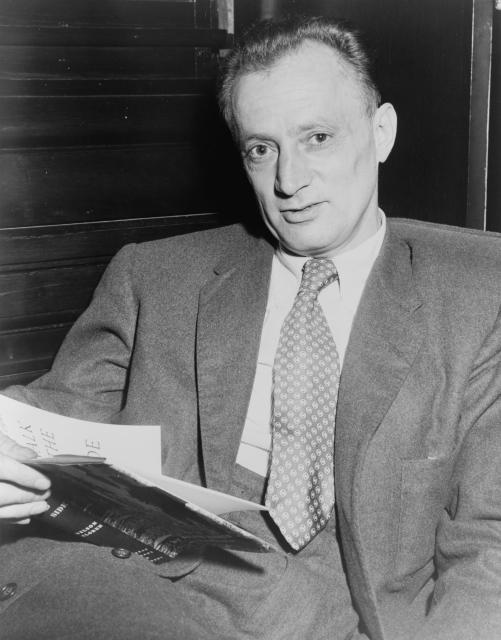
Nelson Algren
 USA
USA- Early Life and Education
- Childhood and Schooling
- Literary Beginnings
- Literary Recognition
- Literary Career
- Connection to Simone de Beauvoir
- Later Life and Legacy
- Death and Literary Legacy
Early Life and Education
Birth and FamilyNelson Algren was born on March 28, 1909, in Detroit, Michigan. His parents moved to Chicago, Illinois, when he was three years old and settled in a working-class neighborhood on the city's South Side. Algren's father was the son of a Swedish Jew who had converted to Judaism and worked as an auto mechanic. His mother, who operated a candy store, was born into a German-Jewish family.
Childhood and Schooling
When Algren was eight, the family moved to Chicago's North Side. The young boy recalled being teased by neighborhood children for being a fan of the "South Side" White Sox baseball team while everyone around him rooted for the "North Side" Chicago Cubs. After graduating high school, Algren attended the University of Illinois at Urbana-Champaign, where he earned a bachelor's degree in journalism in 1931, amidst the Great Depression.
Literary Beginnings
Early Influences and ImprisonmentIn 1933, Algren wrote his first short story, "So Help Me," while working as a gas station attendant in Texas. His arrest and subsequent five-month imprisonment for stealing a typewriter had a significant impact on him, leading him to identify with the societal outsiders and urban outcasts who would later populate his literary works.
Literary Recognition
In 1935, Algren won the first of his three O. Henry Awards for his short story "The Brother's House." His debut novel, "Somebody in Boots," was published the same year but failed to find success. Algren himself dismissed the book as crude and politically naive, later reworking its material into "A Walk on the Wild Side," which he considered his finest work.
Literary Career
Major Novels and ThemesAlgren's second novel, "Never Come Morning" (1942), was praised by Ernest Hemingway but stirred controversy within the Polish-Jewish community of Chicago. Algren was accused of promoting Nazi sentiments, despite being half-Jewish himself. The publication of "The Man with the Golden Arm" in 1949 catapulted Algren to literary stardom. The novel, adapted into a film starring Frank Sinatra in 1955, depicted the seamy underworld of urban America, inhabited by alcoholics, pimps, drug addicts, prostitutes, corrupt politicians, and gangsters.
Connection to Simone de Beauvoir
Throughout the late 1940s and early 1950s, Algren was considered one of America's leading writers. He had a renowned affair with Simone de Beauvoir, who portrayed him as a character in her novel "Les Mandarins" (1954).
Later Life and Legacy
Advocacy for Rubin CarterIn 1975, Algren agreed to write a magazine article about Rubin "Hurricane" Carter, a professional boxer wrongfully convicted of murder. Deeply moved by Carter's story, Algren visited his hometown of Paterson, New Jersey, and decided to relocate there permanently later that year.
Death and Literary Legacy
Algren died of a heart attack at his home in Sag Harbor, Long Island, on May 9, 1981. His posthumously published novel, "The Devil's Stocking" (1983), chronicled his investigation into Carter's case. Algren's body of work is known for its gritty realism and compassionate portrayal of society's downtrodden. He is considered one of the most influential figures in American literature of the 20th century.


