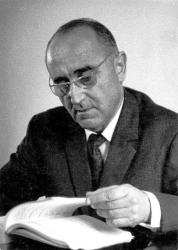
Niels Henrik Abel
 Norway
- Biography of Niels Henrik Abel
- Early Life and Education
- Scientific Work and Recognition
- Teaching and Legacy
Biography of Niels Henrik Abel
Niels Henrik Abel was a Norwegian mathematician who left a rich mathematical legacy for future generations to explore. According to Charles Hermite, his contributions were so significant that mathematicians would have plenty of material to work on for the next 500 years.
Early Life and Education
Abel was born on August 5, 1802, near Stavanger, Norway, into a pastor's family. After completing his parish school education, he enrolled at the University of Christiania (now Oslo) in 1821. Upon graduating from the university, he obtained a degree in philosophy.
Scientific Work and Recognition
During the winter of 1822-1823, Abel completed a significant scientific work on the integrability of differential equations. As a reward for his accomplishment, he was awarded a government scholarship. From 1825 to 1827, Abel embarked on a journey across Europe, where he met renowned mathematicians such as Adrien-Marie Legendre and Augustin-Louis Cauchy. During this time, he published about ten articles in mathematical journals, including the "Journal für die reine und angewandte Mathematik." In the autumn of 1826, he presented a lecture on transcendental functions at a meeting of the French Academy of Sciences.
Teaching and Legacy
Upon returning to Oslo in the spring of 1828, Abel began teaching and soon secured a temporary position as a lecturer at the university, thanks to the efforts of French mathematicians who appealed to the King of Norway, Bernadotte. However, Abel's life was tragically cut short, and he passed away in Frøland near Arendal on April 6, 1829.
Abel's most famous discovery revolutionized the field of algebra. In 1824, he proved that algebraic equations of the fifth degree and higher are generally unsolvable, while also identifying specific types of equations that do have solutions (known as Abel groups). He also made fundamental contributions to the field of integral calculus, studying integrals of algebraic functions, establishing the "Abel's theorem" on the finite number of independent integrals of this kind, and developing the theory of Abel integrals and Abel functions. Additionally, he explored elliptic functions and the theory of equations.
Niels Henrik Abel's groundbreaking work and profound insights continue to shape the field of mathematics even today, leaving a lasting legacy that will undoubtedly guide and inspire mathematicians for centuries to come.