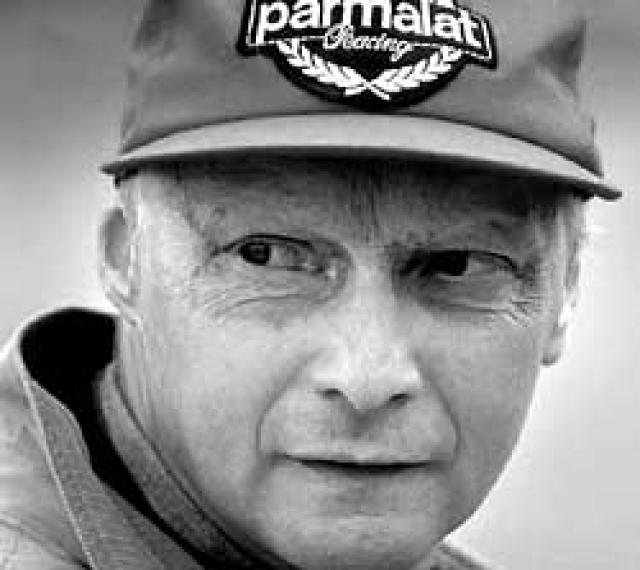
Niki Lauda
 Austria
Biography of Niki Lauda
Niki (Nicolas Andreas) Lauda, an Austrian racing driver, was the winner of the Formula-1 races in 1975, 1977, and 1984. Known for his remarkable achievements in the world of Formula-1, Lauda expanded his horizons beyond racing and ventured into the aviation industry. As the commander of the crew, he received a warm welcome from passengers aboard Lauda Air, the Austrian airline company that he owned.
Currently, Lauda is focused on a new venture in the aviation sector. Having purchased a controlling stake in Aero Lloyd Austria, he is undergoing special training to obtain a license to fly the Airbus. Lauda believes that being a pilot for his own company is a matter of principle. He also acknowledges the fact that being a Formula-1 legend attracts clients to his airline.
At the age of 54, Lauda remains full of energy and constantly takes on new ambitious projects, rather than resting on his laurels. He despises boredom and thrives in challenging situations. Lauda recognizes that the aviation business is characterized by fierce competition, substantial investments, modest profits, and the challenge of working with "normal people," as he refers to regular employees who may not be as driven by results and achievements. When he established Lauda Air, he was astonished to see that his employees would calmly leave work at five o'clock. He had to find a way to motivate them, despite their mindset being completely opposite to his own. It required significant effort to transform these "normal" individuals into employees who would work not just formally, but also strive for results, similar to the approach in Formula-1.
Lauda's extreme experience as an F1 driver has proven to be valuable in making decisions in business. He believes that in both racing and business, one cannot hesitate for too long when making decisions. The ability to react quickly is of utmost importance. Lauda has learned this lesson from his time in the world of sports.
Unlike many other well-known individuals, such as his compatriot Arnold Schwarzenegger, Lauda has no intention of entering politics or prestigious government service. He considers himself too straightforward for such roles, as they require flexibility and the ability to seek compromises. However, he playfully mentions that he might consider running for the position of the President of Austria someday, as it seems to be more of a ceremonial role that involves making visits to other countries, representing the nation, exchanging memorable gifts, and drinking champagne.
Lauda reflects on the most challenging moments of his life, with the most difficult being the crash of a Lauda Air plane in Thailand. Although it was not the company's fault and was instead a problem with the Boeing aircraft, people lost their lives, and he still felt responsible for the tragedy.
During the 1980 Olympics in Moscow, Lauda had the opportunity to visit Russia. He transported a horse to Moscow in his own plane as part of his support for an Austrian equestrian athlete who wanted to compete despite the boycott by Western countries. This light-hearted moment created a memorable flight experience for Lauda.
When he visits the Nurburgring during Formula-1 races, memories of his horrific accident at the same track resurface. However, Lauda believes that dwelling on such memories is futile and can drive one insane. Instead, he focuses on the present and appreciates the changes in the world of racing, although he believes that the current races lack the excitement and challenge that he experienced in his time. The advancements in technology, such as traction control and automatic transmission, have reduced the demands placed on the drivers, resulting in a less thrilling experience.
Lauda acknowledges that he played a significant role in pioneering the practice of signing multimillion-dollar contracts with drivers. He compares each driver to a unique artist who can determine the value of their work. He highlights that the major expenses in Formula-1 teams are directed towards car production, with budgets ranging from $100 to $150 million, while the salaries of drivers range from $3 to $10 million. In his case, he engaged in a battle with Bernie Ecclestone in 1979 to secure a contract extension with Brabham. This negotiation led to a deal worth $2 million, where Lauda proved that he had the power to demand a substantial sum.
Regarding his personal life, Lauda admits that he does not maintain relationships with other former drivers. He does not even exchange Christmas cards, as he believes he is not at that stage of life yet.
In his spare time, Lauda claims that he has none. He is constantly occupied with various commitments and does not have the luxury to think about leisure activities.
Throughout his life, Lauda has prioritized consistency. Following the path he chose, he has always strived to remain unwavering in his decisions.
Looking back, Lauda is satisfied with how his life has unfolded. He would not change anything if given the opportunity to go back in time because he has always been free to make his own choices. Lauda has no regrets, and he stands proud of his accomplishments.


